

Why are you still at work? You’re not getting anything done between now and quitting time. Cut out and stop pretending. Piss Off Early, Tomorrow’s Saturday.
First, a little verse.
***
“We mourn, but with the qualification that, after all, his life was a revel in the felicities of language.”
– Robert Frost from his introduction to King Jasper by Edwin Arlington Robinson
When Edwin Arlington Robinson won the inaugural Pulitzer Prize for Poetry in 1922, I imagine it was a fine day of congratulations and warm feelings from all the other poets. For three years prior, there had been what we now call the Special Pulitzer Prize for Poetry, but that’s retconning. That was then known as the Columbia Prize, and stood apart. Harriet Monroe, writing in celebration of Robinson’s laurels threw in, “Four years ago, when the Poetry Society of America gave its first annual five hundred dollars to Sara Teasdale’s Love Songs, the award, being made in conjunction with the Pulitzer prizes, was falsely attributed to the same origin.” The Columbia put five hundred dollars in the winner’s pocket. The Pulitzer was worth one thousand. Neither was chump change in 1922, but double is considered by most who make their living in verse to be better.
Not that a true poet would ever consider something so crass as money, but on those odd occasions when the subject came up in conversation, it must have been nice knowing, for those of a zero-sum view, that there was more to be contested than had been before. When the second Pulitzer was awarded to Edna St Vincent Millay in 1923 and the third to Robert Frost, I assume along with standard jealousies the warm feelings continued.
In 1925, Robinson won his second Pulitzer. In the audience of the poetry place where all the poets hang out, I imagine heartfelt applause on hearing, because EA, as he didn’t like the name Edwin, was a kinda dour guy but he wasn’t offensive. Maybe he was a little dark, but he was witty dark, not depressing dark. Still, as the crowd dispersed to cocktails and cliques coalesced, jocular between swigs, “You know, there are other poets out there.”
Follow with Amy Lowell in 1926 and Leonora Speyer in 1927. Come 1928, it’s Robinson again. Even Frost, who hadn’t yet won his second, third, or fourth Pulitzer and so was still on the proletarian side, would have been a bit up in arms. The new and immediately prestigious prize so far ran one for EA, two for the rest, one for EA, two for the rest, one for EA. Betting EA versus the field wasn’t a bad play. All the other poets got together in one of their poet places and presented Robinson with an ultimatum: Either EA stop winning Pulitzer Prizes or they’ll tell everyone that his parents wanted a girl and, milquetoast on his male emergence, didn’t name him until he was six months old and when they did, drew “Edwin” from a hat and pinned Arlington on because the stranger they’d just met who physically pulled the name slip was from Arlington, Massachusetts. EA didn’t win any more Pulitzers and the name thing got out anyway, but everybody left the negotiations back in the comfort of those warm feelings from earlier days.
At least that’s what I like to think happened. The wanted-a-girl thing is real. He hated his name. Other poets respected Robinson for his skill, but also because his was the age of “Make it new!” and while everybody was scrambling in various directions to poke and prod the limits of verse, he went a scant backwards and still managed to innovate. Robinson reverted to older forms in relation to the age. He didn’t like a lot of the popular liberties. Per the excellent Poetry Foundation anonymous biographers, Robert Gilbert wrote, “All his life Robinson strenuously objected to free verse, replying once when asked if he wrote it, ‘No, I write badly enough as it is.’” But he went forward with many of his contemporaries in dropping outdated poetic cant for a more straightforward diction. Poets had been at that to some degree at least as far back as Wordsworth, but the idea was suddenly front, center, and reinvigorated with writers like Frost full steam ahead on sound and sense and conversational rhythm. In fact, Robinson’s talent for New England folksiness maybe was a bit much for Frost, as Professor Nancy Carol Joyner writes in the Dictionary of Literary Biography, “Biographers of both poets report that Frost was extremely jealous of Robinson but the reverse was not true.”
Robinson’s charm lies in narrative. He was a great fan of the English poet George Crabbe (1754-1832), whose narrative poetry focused on common people and daily lives. Crabbe wrote in the time of the immortal insult, “silly girls who read novels,” and poetry ceded story to the longer prose. He was a throwback, married to heroic couplets like a… I can’t write “Pope revivalist” referring to Alexander Pope because people will think I meant “Papal revivalist” as if he was one of Dan Brown’s Opus Dei heirophants. He wrote in heroic couplets like Alexander Pope. As a surgeon, Crabbe spoke to folks across the social spectrum and either used their stories and fragments, or saw that there was worth in stories from other than courtesans and set to heroic meter, underlined the point.
Funnily, Crabbe published his first poem anonymously. It was a morality verse about the evils of alcohol. Later he’d write “Sir Eustace Grey,” one of his most celebrated works. “Sir Eustace Grey” presents the hallucinations of a mad man in a mad house and does it so convincingly, it’s widely believed that Crabbe wrote under the influence of opium, a habit he’s known to have picked up some fifteen or so years after his “drinking is bad” poem.
I don’t think I’ve read Crabbe, certainly not in an intentional way, so this is as conveyed by The Cambridge Guide to Literature In English: he imagined a parson perusing records of births, marriages, and deaths and with this vehicle in mind, wrote The Parish Register, a collection of interrelated stories set to verse. Clearly Robinson was impressed. The latter man took from the former the conceit of a community in which he could weave tales and through which he could pepper characters. He didn’t pick up the couplets, but both Crabbe and Robinson took from their predecessors what most of their contemporaries left fallow.
George Crabbe
Edwin Arlington Robinson (1869-1935)Give him the darkest inch your shelf allows,
Hide him in lonely garrets, if you will,—
But his hard, human pulse is throbbing still
With the sure strength that fearless truth endows.
In spite of all fine science disavows,
Of his plain excellence and stubborn skill
There yet remains what fashion cannot kill,
Though years have thinned the laurel from his brows.Whether or not we read him, we can feel
From time to time the vigor of his name
Against us like a finger for the shame
And emptiness of what our souls reveal
In books that are as altars where we kneel
To consecrate the flicker, not the flame.
Most of Robinson’s better known poems take place in Tilbury Town, a fictional community as a backdrop for vignettes; a device like Faulkner’s Yoknapatawpha or Hardy’s Wessex. Few poems mention Tilbury specifically. We’re to assume that this is around the corner or downtown and one denizen may know the other as all presume to share a common atmosphere.
At least two of these poems obliquely appear to be about his brothers. I know he had two. If there are other brothers out there I can’t find mention nor can I find confirmation that there were just the pat three boys. In any case, of the known, Dean was the oldest, Herman the middle, and EA the youngest.
Herman married Emma Löehen Shepherd, upsetting EA as he was in love with her despite an awkward difference in age. EA skipped the wedding and did some petulant poem writing. Things went poorly for Herman professionally, he drank, his wife and kids left him, and nineteen years after the wedding he died of tuberculosis.
Probably Robinson’s best known poem, “Richard Cory,” is about a wealthy man who outwardly has everything a man could want in life. And then he kills himself. The obvious intimation is that, despite appearances, we never know what troubles haunt a man. Emma claimed the poem was about her husband. Herman wasn’t rich, but he had everything EA wanted in Emma, so goes the interpretation.
Richard Cory
Whenever Richard Cory went down town,
We people on the pavement looked at him:
He was a gentleman from sole to crown,
Clean favored, and imperially slim.And he was always quietly arrayed,
And he was always human when he talked;
But still he fluttered pulses when he said,
“Good-morning,” and he glittered when he walked.And he was rich – yes, richer than a king –
And admirably schooled in every grace:
In fine, we thought that he was everything
To make us wish that we were in his place.So on we worked, and waited for the light,
And went without the meat, and cursed the bread;
And Richard Cory, one calm summer night,
Went home and put a bullet through his head.
The older brother Dean was a medical doctor who self-medicated for neuralgia, became an addict, and died as result of an overdose, possibly suicidal. The poem “How Annandale Went Out,” is told by a witness to euthanasia, possibly in defense of his complicity in a trial setting. This isn’t as vague an analogy to a brother as “Richard Cory.” The question isn’t whether it’s about Dean. The question is, is the witness representing EA in his guilt at not stepping in to prevent his brother’s decline and death? Or is the poem told from Dean’s point of view, a witness to his own suicide attempting to explain himself?
How Annandale Went Out
“They called it Annandale—and I was there
To flourish, to find words, and to attend:
Liar, physician, hypocrite, and friend,
I watched him; and the sight was not so fair
As one or two that I have seen elsewhere:
An apparatus not for me to mend—
A wreck, with hell between him and the end,
Remained of Annandale; and I was there.“I knew the ruin as I knew the man;
So put the two together, if you can,
Remembering the worst you know of me.
Now view yourself as I was, on the spot—
With a slight kind of engine. Do you see?
Like this… You wouldn’t hang me? I thought not.”
Teddy Roosevelt’s son, Kermit, picked up and loved Robinson’s collection, Children of the Night, and passed it on to his father. Teddy loved the book and invited the poet to the White House. EA turned the invitation down. He was a poor poet and didn’t have the money for White House audience clothes. In response, the President set Robinson up with a well-paying job with the Customs Office with the understanding that he continue to work “with a view to helping American letters.” Roosevelt went further by convincing Scribner’s to print a second edition of Children of the Night and even reviewing it glowingly himself in the pages of Outlook magazine. I don’t know of another poet who’s received both a literal and figurative Presidential imprimatur.
With the end of Teddy’s term came the end of EA’s soundingly make work government job. He went back home to Gardiner, Maine as, after the death of Herman, did Emma. He was still smitten and started proposing. Two refusals were enough to convince him there was no prospect so he left for New York to be a drunken Bohemian for a while and hang out with other poets and artists. He’d head out of town, reside at various artists’ colonies for a spell and then wander back to New York. As I mentioned before, he wasn’t the most charismatic guy in the world, but there must have been something to his dark humor as, per Wikipedia, at these colonies, “several women made him the object of their devoted attention.” I’m sure his fame helped.
He had a lengthy relationship with Elizabeth Sparhawk-Jones. Theirs was a loose affair. They spent time together at MacDowell Colony in New Hampshire, separated, and took up again on the next mutual visit. He called her Sparhawk and, from Wikipedia, “She described him as a charming, sensitive, and emotionally grounded man with high moral values.” Also from Wikipedia, “They had a relationship that the poet D. H. Tracy described as ‘courtly, quiet, and intense.’” I mention her because her name was Sparhawk and that’s kind of cool, but also because their artist colonies seem so genteel. From my 21st century perch the phrase is tainted by visions of white haired women with too many scarves marveling at how artistically arty they are or nightmarish hippie communes with acid babies and undrivable school buses rusting on berms. I blame Joan Didion.
In addition to the Tilbury Town folk, Robinson wrote Arthurian romances. His final Pulitzer was awarded for his 1927 release, Tristam, which was certainly his most popular book and possibly the last book-length original poem to be a bestseller.
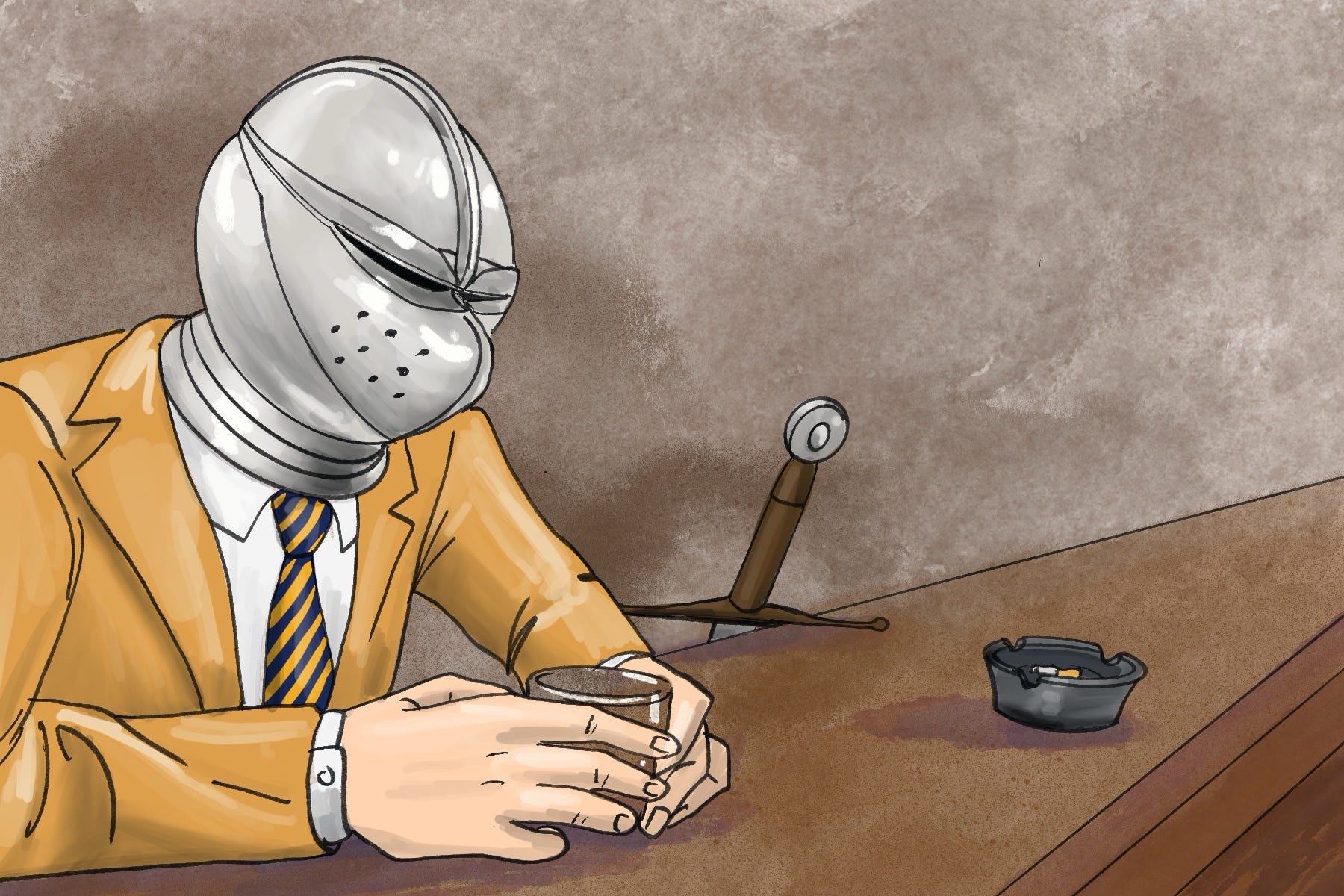
Today’s final poem is autobiographical, so completes a trio of works about the known Robinson brothers. The man wasn’t comfortable in his time, a bit of an Arthurian courtier in Yankee New England. He liked the old forms.
Miniver Cheevy
Miniver Cheevy, child of scorn,
Grew lean while he assailed the seasons;
He wept that he was ever born,
And he had reasons.Miniver loved the days of old
When swords were bright and steeds were prancing;
The vision of a warrior bold
Would set him dancing.Miniver sighed for what was not,
And dreamed, and rested from his labors;
He dreamed of Thebes and Camelot,
And Priam’s neighbors.Miniver mourned the ripe renown
That made so many a name so fragrant;
He mourned Romance, now on the town,
And Art, a vagrant.Miniver loved the Medici,
Albeit he had never seen one;
He would have sinned incessantly
Could he have been one.Miniver cursed the commonplace
And eyed a khaki suit with loathing;
He missed the mediæval grace
Of iron clothing.Miniver scorned the gold he sought,
But sore annoyed was he without it;
Miniver thought, and thought, and thought,
And thought about it.Miniver Cheevy, born too late,
Scratched his head and kept on thinking;
Miniver coughed, and called it fate,
And kept on drinking.
Housekeeping: Someone named Jackson Hinkle is causing trouble in Iran. Apparently, he’s an influencer who took a trip to Tehran to shout “Down with USA” from stage at an IRGC approved rally. At least one Congressman has called for Hinkle’s arrest upon his return to America. If there is no arrest, keep an eye on these pages. Fonda laid groundwork. If Hinkle can go to another country we’re in military conflict with and cheer for our defeat, I think we might be able to do something about Ezra Pound’s public image. Pound was guilty as hell. He got on Italian radio and cheered on Mussolini while saying all manner of bad things about the US. Times change. Aid and comfort doesn’t move the needle like it used to. There are legalities to check into. We aren’t in a declared war, for instance, but there are bombs bombing. Lawyers cost money. Maybe an exploratory Pro-Pound Go-Fund Me? Again, keep an eye on these pages.
[This entry is cross posted at ordinary-times.com]