


You still at work? What do you think you’re getting done between now and quitting time? Cut out and stop pretending. Piss Off Early, Tomorrow’s Saturday.
First, a little verse.
***
There’s a photograph of Leonora Speyer where she looks to be in her early twenties. She was born to some wealth. I can’t tell if her her family was idly comfortable or extravagantly rich. Her father, who died six months before her birth, was Count Ferdinand von Stosch originally of Monze, later of Washington, DC. There’s not much on her in the typical poet biography places and scant to zip on her father. He fought for the Union side in the Civil War, settled in Washington, and died at around forty years old; no information about rank or deeds or cause of death. He immigrated in the 1840s or 50s, so he was a kid when he came. That’s about it. Otherwise he’s an addendum to the bio of the daughter he never met.
An AI search–so take it or leave it–reports the photo is from some time in the 1890s, which I’d already assumed. Leonora showed an early proclivity for music and led a public life. She gave her first public performance in Washington at age ten: Beethoven’s Moonlight Sonata. One source tells me she and her mother sailed for the continent in 1899, when Leonora was sixteen, to continue her musical studies in Brussels. Another tells me she debuted with the Boston Symphony Orchestra at age seventeen. It’s possible they went back for a visit, but I can’t find record of it. As best I can tell, she and her mother stayed abroad, first in Brussels and then in Paris with another violin teacher, until 1891 or 92.
Maybe they went back and forth, maybe she was seventeen when they left, maybe she was sixteen in Boston. No matter the details of her precociousness, Leonora was talented. She was a force on the piano as well as the violin, but there came a time to specialize. Whether she had a preference or felt she had a greater talent for violin is unclear to me, but she chose pure string violin over string/percussion piano in the end. Encyclopedia.com tells me she’d played the violin since her “chin was firm enough to hold it.” Having seen the photograph of her in her early twenties, my first though: “That must have been very, very, very, very early.” It’s not a flattering picture.
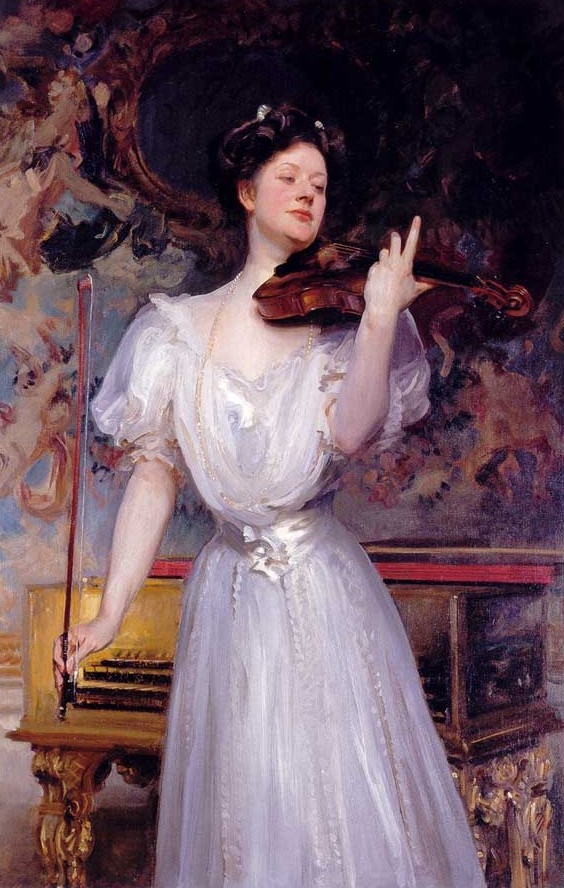
It’s hard to argue with a photograph, but you can chip away at veracity with lighting, shadows, and angle. Her second husband, Edgar Speyer, commissioned John Singer Sargent to paint a portrait of his wife. Sargent completed the work in 1907. It was to become iconic. Edgar ran the British arm of his family’s international financial business and helped put together financing for and did some overseeing of the construction of what became the London Underground. Ties to the family firm’s Frankfurt branch became problematic. In 1915, his naturalized citizen status was revoked and rather than live under wartime suspicion, the family left for New York. By this point, neuritis in Leonora’s shoulder had put an end to public concerts, but she still played salons. The couple bought a pair of homes in Washington Square and built in between, merging the two into a massive eleven-bedroom mansion with an immense music hall. Theirs was a popular place, as Emily E Hogstad writes at Interlude, “Debussy, Elgar, Grieg, Richard Strauss, and countless others visited the Speyers’ famous music room.” They held small concerts by world famous and rising musicians and composers. Gracing a wall of the hall was Sargent’s roughly six by three foot Lady Speyer, the talented, keen, and ever present patron-host. There’s nothing immoderate about her jaw in the painting.
Her friend Kahlil Gibran gives us four views of Leonora. He made several sketches of her but the one I’m referring to is a single piece with four images, Rushmore-like, each a variation of expression, done in charcoal. The leftmost shows her in profile. A prominent bump on her nose, and I suspect from the other sketches that the nose is exaggerated a bit, recalls antiquity; a face on a coin; she’s the noble lady. The next, at three quarters, is soft with compassion and concern. Moving right, the third stares ahead, a woman in full. The final, again in three quarters carrying on the suggested turning motion, strikes farseeing and dreamy.
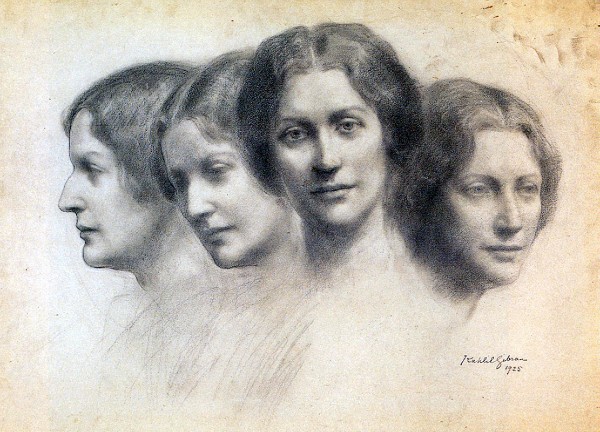
That’s my interpretation. Gibran may have intended aspects of her life rather than of her personality. I’ll insist on the Roman nose profile representing nobility, but by the others Gibran may have meant one to symbolize mother, another musician, and the third the poet she became after neuritis took away the possibility of regular concert performances. The different views and turns of head cast more doubt on the 1890s photo. I’m wryly open to the thought that having expanded on the nose for Rome he softened the jaw across the range for his friend, mumbling about balancing the ledger as rationalization. It’s more likely that 1890s were a cruel time to be photographed.
There’s one last, and it’s beautiful. It’s a touched up photograph I came across on surfing websites. Whether the touch ups were recent computer washes or older paint brush accents on the original, I’ve no idea. There was a period where it was in vogue to have painters finish photos for a portrait-like appearance, but judging from her age in the picture, that practice’s time had passed. She’s older here than in the others–maybe sixty. The clothes, what we’d consider dowdy now but were likely fashionable at the time, help. The British series Midsomer Murders is based on a series of novels by Caroline Graham. They’re well-written and entertaining afternoon passers, but one line from her first book struck me as brilliant. Describing a wiry old woman putting on a raincoat, Graham writes, “She flapped into a Burberry.” It’s concise: elderly energy in the service of venturing out while unselfconciously bundled in frumpiness. That’s the first thing I thought of on seeing the picture. Second, there’s an archetype that pops up in British Science Fiction, notably in 1980s and 90s comic books, of a luminous homeless woman, shabby in her antiquated clothes. A segment of modern audiences equate that look with wisdom. I’m sure that figures into my impression, but on looking at this picture taken before the urban fantasy archetype popped up, I wonder at whether the archetype was distilled by genre writers or was just laying around waiting to be noticed.
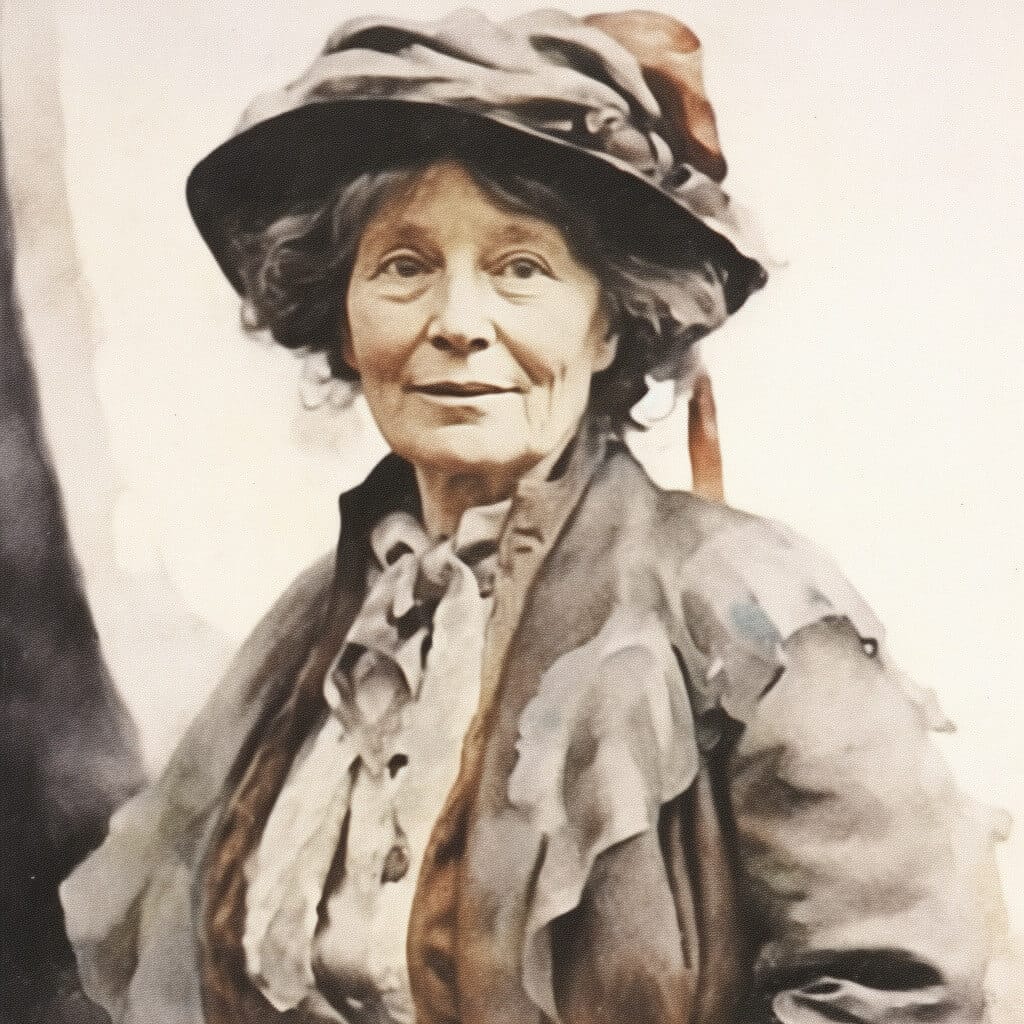
Of course, her get up wasn’t frumpy at the time. The immediate thought on seeing a beautiful older woman is that she must have been gorgeous when she was younger. That’s not fair. I’m not certain it’s correct either. People fell in love with the woman in the touched up photo. She conducted crowds with music. She scorned a first husband, lost a second. She played and when she couldn’t she wrote. She taught poetry at Columbia University, served as president of the Poetry Society of America, and talked shop with Amy Lowell. She launched musical careers. Whatever she was or wasn’t but for taut skin doesn’t matter. There’s nobility, mother, concern, musician, poet, dreamer, teacher, and matter of fact acceptance. It’s a good picture. Optimistic.
Below is the opening section of the title work from her 1926 collection Fiddler’s Farewell, for which she won the 1927 Pulitzer Prize for Poetry. There’s sadness and optimism and acceptance throughout and for all the promise of the precocious musician, it was written by the seasoned woman who turned to poetry.
from Fiddler’s Farewell
Leonora Speyer (1872-1956)Fold now the song within the songster.
Small sturdy one,
Roistering down the centuries,
Drunk with the fiddlers’ fingers,
(Never a dearth of these,
The living crowding where the dead have been),
Pure promiscuous dandled violin!Cæsar of sound, my songs in passing, cry,
Morituri te salutamus!—and passing, die.Fold now the song away.
Close the lid down
Upon the gradual dismay
Of disconcerted singing,
Unloose the fingers’ clinging
That has so lost its cunning,
Turn from the faltering renown,
Fame of the little town
After the flag-hung city;
Deny the ruin pity!
Pity? Yes, for the failing song
That like a droughty streamCrawls, drips
Over an arid land,
(Yet deep enough to drown)—
O violin that slips
From the relinquishing hand,
Brown brightness hid—
Let fall the incurious lid.
[This entry is cross posted at ordinary-times.com]