

This essay is not a novel. I’m drinking a cup of coffee, so there’s action. Since I actually am drinking a cup of coffee you might say that this essay is not a roman à clef. I’m going to introduce an apple which I am not actually eating. Then, I’m going to have the protagonist choke on the first bite. I have a sense of timing so I’ll leave that for a moment to build suspense; let the reader wonder what’s going to happen next.
In the end, the fictitious apple doesn’t kill thinly veiled fictitious me. But frozen in a moment of uncertainty, caught in, as the slice is in what a little bit of authorial research may or may not confirm is the epiglottis, we have an inflection point.
In the still moment between possibilities I confront evidence of a spiritual existence I’d suspected, hoped and relied on, but suffered the same anguishing doubts over as one does over any article of faith in what’s desired.
The body acted on its own. It retched, contracted where contraction might help, looked to expel, was persistent. The mind didn’t do any of that autonomic stuff. It was onlooker, chronicler, and judge as reels of experience ran out of sequence before it. Foibles. Triumphs. Missed Kisses. I was I, separate from the choking meat, watching my life, paused in recall. Every detail reviewed. I knew my evaluation didn’t matter a whit, preliminary to that of something greater. It would have neither bearing on that ultimate judgment nor give standing for appeal.
The apple dislodged and vanished in tears and an oriental rug. I re-integrated. Knowing I was doing so. Knowing I was a soul in a body; a coat I wore. I saw through a window into the world, firmly tethered to something higher. I learned and resolved.
I’ve satisfied a few middle school requirements: a character undergoes change, Man vs. Nature, Man vs. God, and by contrasting, Man vs. Man and Man vs. Himself. The bases are covered and the lovable protagonist has undergone change.
Nobody should put up with me calling this a novel. Even a high school kid looking to dodge an onerous reading assignment would be too proud. If I put a chapter break in right here, it wouldn’t matter a lick.
That this isn’t a novel doesn’t diminish the work in any way nor would it improve if it were so called. The essay-not-novel remains word for word as it is no matter; brilliant and harrowing plot, subtle characterization, and emotionally wrenching. This piece connects with readers in an amazing and unexpected way no matter what genre damnable critics assign it from their categorical grab bag.
So, why do so many people indent lines awkwardly to call their work poetry? Why do they insist on the designation?
I feal the lines, blue
potent potential mocking white
and feather tips old men waste
against Polished grain
Begin anew on Sunday
Righteous din, big nation
we are all on stolen land
That’s my rhythm-less free verse contemplation of the blank notebook page on the desk to my right while someone on TV makes background noise fun of a Grammy winner. It took half a minute to write and most of that was deciding whether or not to feign religious disdain by not capitalizing “Sunday.” Give me grants.
I kinda like the “Righteous din, big nation.” I can’t decide about “feal.” In any case, it’s a crappy bit of nonsense indented and unpunctuated, as that vogue comes and goes, with random capitalization. There’s no craft beyond the Sunday decision. It’s not a poem. It’s not even broken up prose. Whatever it is, it’s dressed up in poet-face. That kind of thing passes more often that I’d like.
So much similar by so many is out there bound and hailed as poetry. Why?
It certainly isn’t the money. I think it was in James Matthew Wilson’s The Fortunes of Poetry in an Age of Unmaking – though I haven’t been able to confirm by picking and scanning through the book so apologies if I’ve misremembered – where I read that publications generally pay more for flash or micro-fiction than they do for poetry. A sentiment laden block paragraph looses value when you indent.
It must have to do with prestige. Calling your written musings poetry carries panache. We like poets. We like having them around. At least we like the idea of having them around so long as they don’t bring the room down. (They can even do that if they bring the room down in a way that lets everyone affect understanding and caring about a Big Idea.) Their presence or acquaintance impresses others and makes attractive. We dwell in the company of unique curiosities. Poets hold grand concerns, love passionately, think intently, and here I am in the midst of one. I must be pretty deep too. People like to sleep with people who are deep. So goes the thinking. Actual poets are interesting people if you talk to, rather than display, them. That’s tediously old-fashioned.
Poets get a lot of leeway. Most guys who pull over busloads of people, kill all the men, and do the same to all the women and children they can’t find a use for are rightly despised. But Che wrote poetry. Look at all the sophomores parading around with his picture on their shirts.
Of course, a lot of the image is claptrap. Poetry means making. It’s a craft worked on by people with certain aptitudes: for rhythm and sound, vocabulary and overlap, perception and history, time and change. These people take all these things for which they have aptitudes – things which all exist alone or in combination outside of poetry – and subject them to discipline.
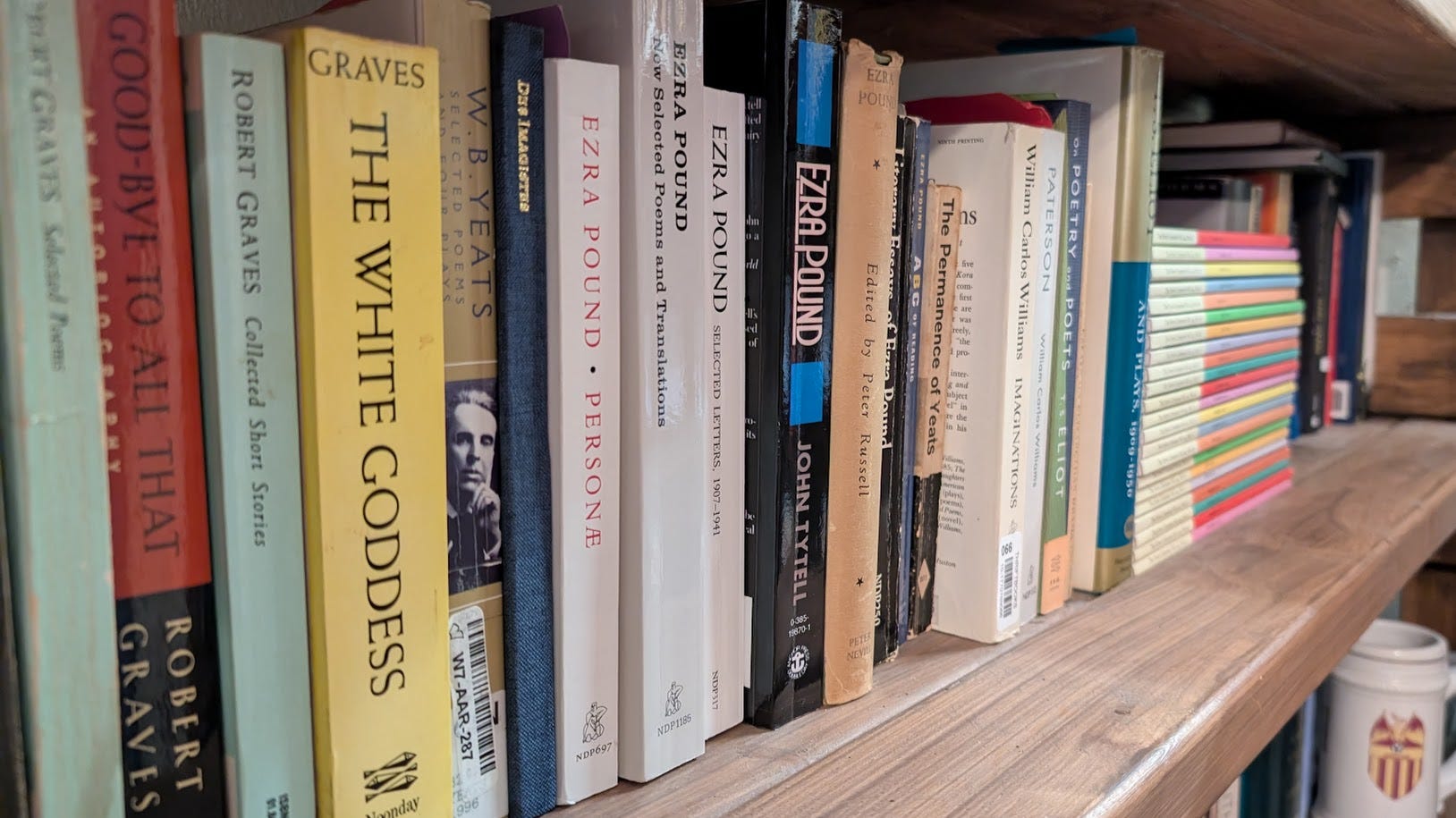
To dismiss free verse is a mistake. Robert Frost’s Country Club quip that writing free verse is like playing tennis without a net or handball without a wall aside, free verse is damn hard to pull off. Anyone who thinks otherwise should spend an afternoon with Robert Graves and Laura Riding’s A Survey of Modernist Poetry. In Chapter III, they break down an ee cummings poem to give a sense of what goes in to making a poem from unmetered lines. Unfortunately, that some poets are successful means every poor fool is licenced to try. What they offer is often – and this time I’m certain I read this in Wilson’s Fortunes of Poetry – “discontinuous juxtaposition.” “Irons unplugged/Robins lost in wormspace/Screaming shattered cow song.” That sort of crap. Sometimes they offer something cogent and poignant; perfectly fine prose if left without devices. In either case, desire doesn’t make poetry no matter how poetic the sentiment.
That want to express yourself is natural. Doing so in print is laudable no matter how successful the attempt, but no matter how passionate the expression, it is not automatically poetry. We know this, and calling any such meaningful (or not) writing such diminishes poetry as an art form. An angry goose honking is expressing itself. The triumph of poetry is in imposing order to expression.
Apropos of nothing: What’s the deal with novellas? They’re pretty short, right?