

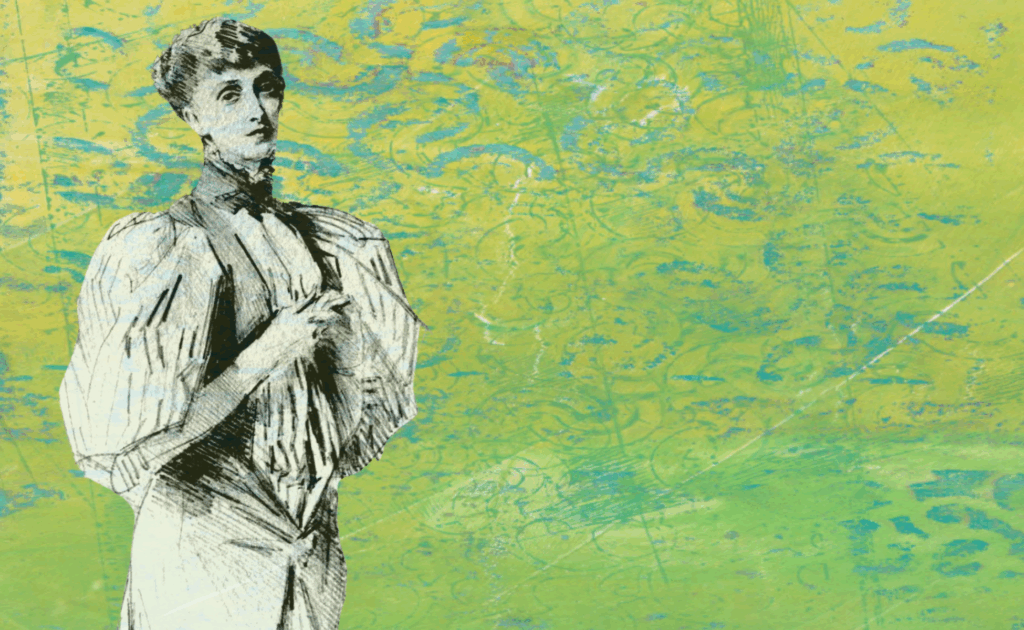
I found Alice Meynell in Yeats’s Oxford Book of Modern Verse. The Oxford verse series indexes by poem number, rather than page. So if you look in the back for Meynell’s “I am the Way,” you find it referenced as number 32, meaning the thirty-second poem in the volume rather than, as you’d expect from a lifetime of index use, that it is on page 32. But as it happens, “I am the Way” is both poem number 32 and found on page 32. I noticed that as I flipped though Yeats’s book and it fortunately struck me as portentous as portent gets on a sitting-around-reading afternoon. Otherwise, I might never have given Meynell the reading she deserves.
“I am the Way” is a fine introduction. She was a devout convert to Catholicism and known in her time as an enterprising publisher and renowned as an essayist. These days, she’s better known (only slightly better as few have ever heard or read her name) for her poetry. It is more likely that Yeats’s contemporary readers, even readers already drawn to the Oxford verse series, would know her prose. That speaks to the smashing power of her prose more than diminishes her verse; she was in the conversation as a possible Poet Laureate after the death of Tennyson and again after the death of Alfred Austin, though the position was never offered.
My wife and I once had drinks with NYT bestselling fantasy author Steven Brust. He talked about being “famulous,” a confabulation of fabulous and famous. He spent most of his life—grocery shopping, dining out, walking through museums—as anonymously as the rest of us. But whenever he wanted to feel famous, he would walk into a sci-fi/fantasy convention and get mobbed like a Beatle. Then he’d leave and go back to regular life as a regular guy. It was the best of both worlds; fame and adoration on tap. Meynell wasn’t quite a regular gal with a regular life. She was a publicly respected figure. Among poetry fans she was a great deal more. Not quite the bifurcated existence Brust revels in, but she was a star in different circles for different reasons. So, she worked with her husband. He promoted and produced Catholic journalism where she stuck to literary and social criticism. Among poets she was revered. She was, notes Alex Wong in his editor’s introduction to the collection Alice Meynell: Selected Poems and Essays, as the Inkling Charles Williams wrote, “‘the Catholic versifier, critic and protector of poets.”
It’s fitting that Yeats would begin with a devotional. The title is easily recognizable as John 14:6, to which she responds with an affirmation or acquiescence in the first line. She is confident in not knowing. She has faith that following is a goal in itself, even though she isn’t certain of the end. The persona accepts herself as a creature caught in time, “of process,” and incapable of knowing outcomes. For her it is the process—the way—that is salvation whether there is “repose” or not.
I am the Way
Alice Meynell (1847-1922)Thou art the way.
Hadst Thou been nothing but the goal,
I cannot say
If Thou hadst ever met my soul.I cannot see—
I. Child of process—if there lies
An end for me,
Full of repose, full of replies.I’ll not reproach
The road that winds, my feet that err.
Access, approach
Art Thou, Time, Way, and Wayfarer.
The final stanza is clever. Are “Access” and “approach” commands or boons granted to those willing to follow? Kimberly Kristine Rodda, in her thesis, “Doubtful Forms: Uncertain Belief in Victorian Women’s Writing,” notes that with “my feet that err,” she sets up the reader to overly stress the second syllable in “Wayfarer,” where to fit the form, stress should land on the third. The poet teases: We stumble on a path, but that’s okay. The proper metric way is laid before us if we see fit and faithfully follow.
The way, the idea that salvation is found in doing, occurs again in a shorter poem.
Via, et Veritas, et Vita
“You never attained to Him.” “If to attain
Be to abide, then that may be.”
“Endless the way, followed with how much pain!”
“The way was He.”
The poems appear sequentially in the 1913 edition of Collected Poems of Alice Meynell. I don’t know how much involvement she had in the layout, but I’m operating under the assumption that the second serves as exclamation point to the first: “You shoulda!”
I read through Meynell’s Wikipedia page, her mini-bio by the excellent anonymous biographers at Poetry Foundation, her Britannica page, and Kimberly Kristine Rodda’s thesis and others before I got to Alex Wong’s introduction. Had I started with Wong, I would have read his admonition that “Meynell” rhymes with “fennel.” It was too late when I encountered it. Her name formed in my mental sound studio as “May-knell,” the shape of the word set over the course of an afternoon’s reading, and so it shall remain despite late findings. I could have mentioned “fennel” to you at the outset, but saved it till here around the middle to see what happens. Maybe you can course correct. I don’t think you can.
Both Wong and Poetry Foundation mention that Meynell had a bohemian upbringing, but neither offers much by way of how-so other than to tell us she grew up mostly in Italy, which seems evidence of an Italian upbringing. Her mother was an artist and musician and her father was the a scion of serial illegitimacy a couple of generations gone from a Jamaican plantation and distantly related to Elizabeth Barret Browning. Her father was also close friends with Charles Dickens, who’s said to have had a tremendous crush on her mom. I don’t know that any of that qualifies as bohemian.
She seems to have had a bohemian side as an adult. Like mom and dad, she had writerly friends. She counted among them D.H. Lawrence, Mrs. Browning and her husband, and Harriet Monroe, to name a few. She modeled for John Singer Sargent, which certainly sound salacious, even though I’ve found nothing suggesting it was. Wong prefaces a list including the poet Coventry Patmore, the poets/novelists George Meredith and Katherine Tynan, and the poet Agnes Tobin with “literary friends (or admirers, in more than one sense).” That sounds like it means what I think it sounds like, but evidence runs contrary.
Patmore was a problem. He became enchanted with Alice and then jealous of her husband. No affair occurred and the Meynells ended their friendship with the man. George Meredith had a crush, much like Dickens for her mother, but it was a playful one. “Admirer” is apt in his case. Memoirs, including one written by their daughter Viola, describe the Meynells as committed, chaste, vocally Catholic, literary salon folks with eight children, seven of whom survived past infancy. Theirs was a happy marriage.
Of the lost child, she wrote this touching work.
Maternity
One wept whose only child was dead,
New-born, ten years ago.
“Weep not; he is in bliss,” they said.
She answered, “Even so.“Ten years ago was born in pain
A child, not now forlorn.
But oh, ten years ago, in vain,
A mother, a mother was born.”
“Renouncement” speaks of a potential scandal. Nine years before marrying Wilfrid Meynell, Alice fell in love with Father Augustus Dignam, the priest who ministered her catechism and received her into the Church. That’s sort of back to front. You usually hear about affairs with clergy as someone is on the way out rather than in. I can’t speak to whether her feelings were reciprocated, only that the relationship was reportedly never consummated. That may mean a torrid affair stopped short, there were letters, they exchanged glances, or it was entirely one sided. In any case, nothing but a poem came of it.
Meynell wrote “Renouncement” shortly after her 1968 conversion. She was wise enough to leave it out of her early collections, only publishing after twenty years passed. Reading, you get the sense that her renouncement is of her feeling for the priest, not the priest himself; that the “thee” in the opening line references her love for the man rather than the man.
Wong writes of the final sextet:
“a technical marvel of poetic movement, convincingly expressive of the struggle of conscious willpower to cope with the flooding power of what cannot always be kept at bay… as if she were repeating and prolonging the thought, excusing her dreaming self as much as possible while postponing the dream for as long as possible.”
It is said to be her most anthologized poem.
Renouncement
I must not think of thee; and, tired yet strong,
I shun the thought that lurks in all delight—
The thought of thee—and in the blue Heaven’s height,
And in the dearest passage of song.
Oh, just beyond the fairest thoughts that throng
This breast, the thought of thee waits, hidden yet bright;
But it must never, never come in sight;
I must stop short of thee the whole day long.
But when sleep comes to close each difficult day,
When night gives pause to the long watch I keep,
And all my bonds I needs must loose apart,
Must doff my will as raiment laid away,—
With the first dream that comes with the first sleep
I run, I run, I am gathering to thy heart.
I come across poets I’ve never heard of regularly. Finding on that I hope to return to often is a treat. I haven’t read beyond one of Meynell’s essays, so there’s that pile of happy reading realized as well. And I found her because I’m silly enough to giggle at the 32 page/index thing. Being goofy pays off every now and again. Felix Culpa.
[This entry is cross posted at ordinary-times.com]