


It is rainy and depressing and awful here for those who like to go outside or look out windows. Has been for a week. It’s cold, too. I’m frustrated with my senses. I don’t know how cold. If I practice, say listening to music in a formal teaching setting, I suspect I’d know a C from an A from a C flat soon enough. I’ve been on this Earth for decades and still have to check a thermostat to see how cold it is. I know it’s cold, but if I say it’s in the forties it may well be in the fifties. What a weak and imprecise sensory apparatus we wear. Defective.
I don’t know what the weather is like where you are, either. But if it’s nice out, go enjoy it. Piss Off Early, Tomorrow’s Saturday. Friday afternoons are fun if you’re free.
First. A little verse.
***
“But first, a historical fragment, a digression: early in the century, Pound, poet of unsurpassable ear, declared war on the iamb. What followed, and indeed surrounded this act, was a period of enormous and profound linguistic discovery, not all of it directly related to Pound’s imperative, but all of it in some manner a shucking of constraints, all confident authority and easy bravura, as though the past were being dared to stop this inspired future. And certain of the tastes of the present moment can be traced to what we now call the Moderns, with that ominous upper case, principally our bias toward the incomplete, a taste that seems to treat the grammatical sentence as Pound treated the iamb: a soporific, a constriction, dangerously automatic and therefore unexamined.”
– Louise Glück, “Ersatz Thought,” American Originality: Essays on Poetry
I’m not a huge fan of Louise Glück’s poetry. If she were alive, I doubt she’d care one whit. People who give out the Pulitzer, the Bollinger, the Nobel, and name US Poet Laureates have already come down on her side of the taste equation. I should add that on this site I’ve held her up as a prominent practitioner of dreaded poets voice and managed not to detail any dreams resulting from Glück reading-induced narcolepsy.
That aside, I genuinely respect the woman as a poet and theorist. Her essays are brilliant, ranging things. She treats bits of process laity realizes as essential when brought up, hovered on the edge of should-have-know before. I went to the library wanting theories on American poetry: what defines it, what the rebels and revolutionaries like Whitman, Dickinson, Pound, Eliot, and Stevens were rebelling against. I have my own thoughts, but I wanted confirmations and challenges. My favorite librarian was off, but a new and yet unranked librarian suggested the above American Originality, by Glück. Strong debut for the new librarian.
I do have one more complaint about the Nobel & Poet Laureate: The introductory few pages, under the heading “American Originality,” was so full of walk backs and qualifiers about the imaginative nature of Americans conception of themselves and their society it played more like a nervous and uncertain ingenue pitching herself to Vassar admissions than the confident critic she reveals in later essays; taking pains to ensure the reader knows that attitudes and assumptions she observes are not necessarily her own. That one was dated 2001, so before the Nobel and Pulitzer, but she’d picked up at least three honorary doctorates and a Guggenheim Fellowship. She didn’t need to explain herself. Just know that if such things bug you, persevere. It doesn’t last long.
In “Ersatz Thought,” Glück discusses Modern and contemporary uses of fragments and non sequitur. Of the former, she writes “variety is suggested through non-being, through unspecified (because not articulate) meaning, or through deliberate non-meaning.” It’s an effective tool but, “How much looseness, or omission, or non-relation, is exciting? And when do these devices become problematic, or, worse, mannered?” The gesture becomes just another technique, cliché by abuse. A good poet must be careful and certain in deployment.
Not everyone is. It’s useful to consider how and why the innovators did as they did.
Robert Graves and Laura Riding wrote about this back when blanks and pauses seemed new and fresh on the scene. Specifically, they wrote about E.E. Cummings’s “Sunset.
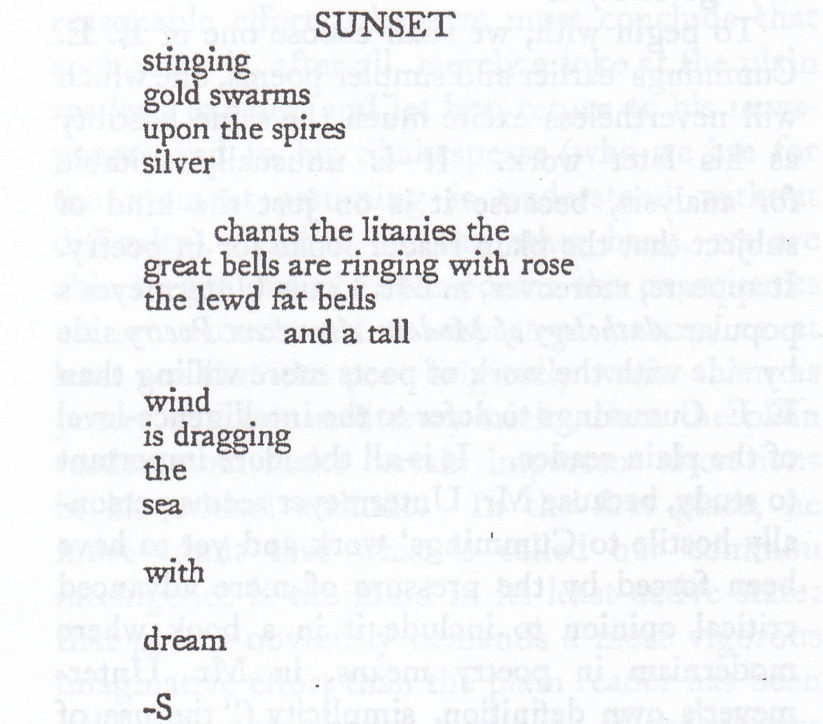
The indention and spacing matter. Word and LibreOffice commands don’t translate properly for typesetting here, thus the picture scanned from Graves and Riding’s A Survey of Modernist Poetry, true to Cummings’s intended form.
Before I get to the poet’s commentary on spacing and blanks, I want to mention my favorite effect found in the poem, one achieved through playful or clever alliteration.
You can’t ignore the “-S” at the bottom, especially in a poem by a poet famous for his lower case fetish. To what purpose? Why does he leave it there? Why does he capitalize it, set it as prominent? He’s a very technical writer, deliberate. I’ll direct you to an earlier POETS Day that covers his syntax. What is he telling us here?
Starting with the title, “Sunset,” we have two strong sibilants; hissing s sounds. That’s repeated immediately with “stinging” and again with the first s in “swarms,” “swarms” ending s a variant sounding as z. The s to z is repeated in “spires” before an s in “silver” ending the run, the last hiss giving way to “chant[z],” “litanie[z],” “bell[z],” “ro[z]e,” “bell[z]” again, and “i[z].”
The sun is setting, softening as the hiss transitions and becomes a buzz. The next “s” is an s, beginning “sea” harsh of a sudden and announces itself as the new central image, taking up the sound that slipped the sun as it it went down. The “-S”, enigmatic, sets the reader looking for its reason, alerted.
The double break lines set rhythm, troughs between waves. Graves and Riding say the breaks do the job of rhyme, measured silence in place of echo.
Every so often you’ll read that Cummings was too clever by half and too indulgent of his ingenuity. He’d lose a poem for showing off. Too enigmatic or riddlesome, Graves and Riding warn, and the poet risks being solved like a crossword puzzle, leaving no reason for a reader to return to the solved poem. I think that’s true, but his tinkering and misfires are the price of wonderful technical displays like this one, matching sound to concept.
Graves and Riding write that “Sunset” is a stripped poem. It’s a refutation of the Victorian, a tradition grown stale and perfunctory. They say the poem is a “suppressed sonnet.” Of the fifteenth line they write parenthetically, “the fragmentary line, -S, being an alliterative hang-over.” If it only hints at form, it fits content. Like traditional sonnets, the first eight lines, the octave, present a postulate or question, in this case that the sun is setting. The final six, the sextet, provide a resolution. In the octave here, we have the sun setting. In the sextet, the sea takes prominence.
As to form, Graves and Riding suggest that Cummings offers a poem as it would appear when all the obligatory syllable counting, rhyming, and exposition are stripped away. To demonstrate, they take his language and imagery, expand on the religious nods, assume their suspicion he took inspiration from De Gourmont is correct, and write a sonnet as they think his would appear were it a traditional work.
Sunset Piece
After reading Rémy De GourmontWhite foam and vesper wind embrace.
The salt air stings my dazzled face
And sunset flecks the silvery seas
With glints of gold like swarms of bees
And lifts tall dreaming spires if light
To the imaginary sight,
So that I hear loud mellow bells
Swinging as each great wave swells,
Wafting God’s perfumes on the breeze,
And chanting of sweet litanies
Where jovial monks are on their knees,
Bell-paunched and lifting glutton eyes
To windows rosy as these skies.And this slow wind—how can my dreams forget—
Dragging the water like a fishing-net.
Two things to note: They extend the poem a line with the final couplet in order to replicate the slowing pace of the original, and it’s intentionally ungainly in order to highlight the unnecessary ornament Cummings refused.
The idea is not to reject standard poetry, but to point out how silly it was allowed to become. Fitting meter is laudable, but not if fitting enlists a horseshoe. The idea of the poem is supreme. “Vesper wind,” “glints,” and “Swinging as each great wave swells” add nothing. By forcing conventions, albeit in as clumsily a way as they could get away with, they try to show that care of poetic ideas in crafting is more important than crafting to a something predetermined. Rather, they tried to show that Cummings was showing that care of poetic ideas in crafting…
They warn,
“But when conservatism of method, through its abuse by slack-minded poets, has come to mean the supplanting of the poem by an exercise in poet craft, then there is a reasonable place for innovation… Further than this it should not be allowed to go, for poems cannot be written from a formula. The principal value of a new method is that it can act as a strong deterrent against writing in a worn-out style.”
And then, seventy years later, when those innovations have themselves become commonplace, trite unless handled carefully, we go back to Glück:
“I prize (as writers are prone to prizing) instinct, guesswork, nerve. But it may be that certain forms and choices need to be reviewed more closely than others, particularly those forms in which theory and intention displace scrutiny. I think we should question these choices a bit more, in the cold dawn.”
I’ll add—I’m paraphrasing from his routine—wisdom from Eddie Izzard:
“There’s a fine line between hip and groovy and looking like a dickhead. And once you’ve crossed that line, it’s very hard to get back to hip and groovy.”
Poets, beware fragmentation. Use it wisely, with trepidation.
[This entry is cross posted at ordinary-times.com]