

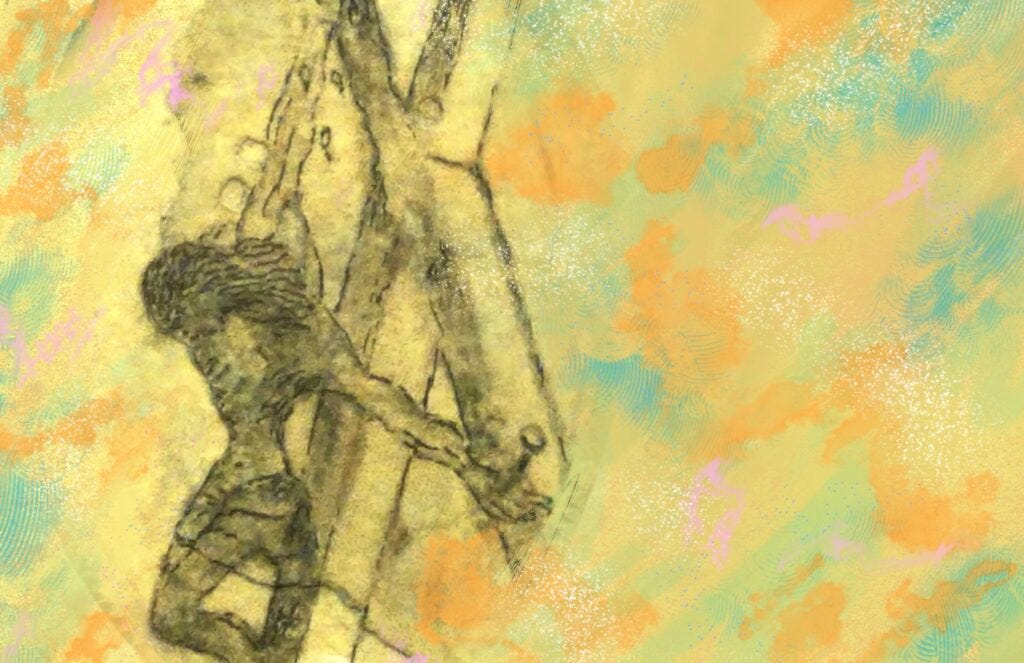
Happy Easter and Ziessen Pesach, if I have that right. All to all.
There may not be work to get out of, but here’s some pseudo-POETS Day mystic verse.
***
When Juan Yepes, ordained John Matthias and later changed to John of the Cross, died in 1591, crowds thronged his viewing, tearing away pieces of the beloved spiritual leader’s burial clothes as mementos. There was impressive competition for his remains.
He was originally buried in Ubeda where he died. Two years later, he was relocated on the sly. The monks at Segovia felt that since he’d been prior of their monastery, they had claim to his remains. They left a leg behind for the Ubeda folks and donated an arm to be venerated in Madrid, but the bulk was whisked away by the Segovian interests. An appeal to Pope Clement VIII in 1596 put the Ubedans back in the game. The pope ordered John’s remains sent back. There was rumbling and arguing. In the end, the Ubedans added the other leg and the arm that wasn’t in Madrid while the Segovians held onto his head and torso.
I resisted saying St John had been the “prior prior” above, so I feel I’m entitled to make an “everybody wanted a piece of him” crack here: Everybody wanted a piece of him. People were different then.
St John of the Cross was a great reformer. The Carmelite order was considered lax at the time of his joining. He began his clerical vocation with the Carthusians, specifically because they stressed solitude and meditative prayer. It was a meeting with St Teresa of Avila (Rome: right foot and piece of upper jaw, Lisbon: hand, Rhonda: left eye and left hand, Alba de Torres: left arm and heart, Paris: finger, Sanlucar de Barrameda: finger) where she laid out her plan for returning the Carmelites to their abandoned “Primitive Rule”—rigorous study, meditation, severe fasting, and times of silence—that caused him to reconsider and join her in her cause.
Omer Englebert does Teresa a disservice in his often cited Lives of the Saints. He writes “At the age of seven she ran away to join the Moors who, she thought, would consent to cut off her head. Cheated of martyrdom…” He makes her sound like Tracy Flick. She did run off to fight the Moors with her brother at age seven, but her uncle found them just outside of town and brought them home. Pace Englebert, it sounds like a “ran off to join the circus” adventure more than an honest death wish. Imagined youthful glories passed. She wasn’t keen on becoming a nun at first. It appears her family applied pressure and she caved, but as a last gasp at independence joined the nearby, per Wikipedia, “easy-going Carmelite Convent of the Incarnation” as what must seem to modern readers as a comically minor act of rebellion.
She learned quickly that the religious life was her calling; any hesitations fell away. The laxity surrounding her became a hindrance. She was blossoming into mysticism and there were distractions. It’s a longer story than this, but she wasn’t able to recreate the Carmelites to her wants, though she was able to form a subgroup, an orthodoxy within an orthodoxy that split and gained independence as the Order of the Discalced Carmelites under Papal decree in 1580. Teresa wrote extensively on prayer and meditation. In John she found an apt pupil and encouraged his gift for poetry. The two went on founding convents and monasteries respectively. They must have made for a formidable side. Both would be named among the thirty-eight Doctors of the Church, Teresa the first woman so honored.
In last week’s POETS Day I touched on Roy Campbell’s travails at the outbreak of the Spanish Civil War. The Carmelite brothers entrusted with the personal papers of St John asked Campbell and his wife to hide the papers in their home, afraid that the communists would turn on the monastery. Their fears were grounded. Republican forces burned the monastery library and shot all seventeen monks in the street. Earlier that day, the Campbell’s home was searched. By his telling, the soldiers passed repeatedly by the trunk in which St John’s work was hidden. They rested their rifles against it, but they never looked inside. They would have likely been killed if they had, but Campbell believed St John himself interceded and saved his family. He vowed to translate the poetry into English in thanks.
Roy hid the trunk and escaped Spain, but returned two years later in 1937 as a journalist and recovered it; managed to get the originals back to the Carmelite order. In 1939, Campbell joined the English Army at the age of thirty-eight. He had a miserable time in boot camp, but an officer recognized him and became very upset on hearing Campbell swore off poetry to focus on fighting. Something in the officer’s protest affected him. He reconsidered and started translating St John in the evenings after drills. It took him eleven years to finish, but this being Campbell, he claimed St John inspired him and in a feverish few months it all was revealed.
The Poems of St John of the Cross brought more success than Campbell had ever known. Kathleen Raine wrote in the New Statesman, as provided by Peter Alexander in his Roy Campbell: A Critical Biography:
“Of all living English poets, Roy Campbell is the most masterly in his use of rhyme, and he is able to use metre so as to convey a sense of internal passion. He has reproduced the Spanish rhymes and metres as closely as possible, and yet his English versions have the freshness of original poems.”
The Observer called the translations a triumph. He was popular again. His finances were finally in shape. Stephen Spender, of whom last week I mentioned Campbell punched on stage because Spender planned to accuse him of Fascism in a speech, was set to give the Foyle Prize for Poetry. He had no idea who he would be honoring until immediately before the ceremony. You can image poor Spender on learning that he’d be on stage with Campbell once again, this time honoring him. Phantom jaw pains rearing. Per Alexander, “the two men shook hands with the utmost cordiality, in marked contrast to their previous encounter.”
“Were I superstitious I should say San Juan brought me luck,” Roy wrote.
This week’s poem is often referred to as “En Una Noche Oscura,” by its opening line. St John didn’t title his poems. Alternately it is “La Noche Oscura del Alma,” or “Dark Night of the Soul” in English.
Christian mysticism deals with preparation for and contemplation of communion with God. It was the belief of St John that we must shed ourselves and all our notions and imaginings to be open to the unimaginable presence of God. There can be nothing left.
The theme repeats throughout his work.
Without support, yet well supported,
Though in pitch-darkness, with no ray,
Entirely I am burned away.
And,
This life I live in vital strength
Is loss of life unless I win You:
And thus to die I shall continue
Until I live in You at length.
Listen (my God!) my life is in You.
This life I do not want, for I
Am dying that I do not die.
To some he went too far. A state of forgetting he insisted is necessary, a complete wipe of our well-meaning but flawed understanding, for divine communion. Even the lessons of the Church must be set aside when in the mystic state to allow for a fuller understanding direct from God. Catechism was true but tainted because nothing of man is perfect. It was an obstacle; preconceptions in the light of purity. Conrad Pepler, O.P., in his afterward to the Cluny Press edition of Campbell’s translations writes,
“[St John] says, following perhaps the lines of this way of analysis, that images and sounds and the like may be used by beginners in the love of God, but that they should be no longer necessary when the soul has progressed. Sacramentals such as the crucifix are to be unattractive or at least crude in their artistry lest they should distract by their material beauty and human skill.”
And then he writes divine verse? Presumably, ecstasy for beginners.
Early editors removed language stating that “memory must be emptied of all its impressions,” and replaced it with “twenty lines of praise for the memory of Christ” and a brief exemption from forgetting for Jesus and his humanity. St John was briefly imprisoned and tortured by less reform minded factions of his own order. There were during his lifetime and after, efforts to suppress or soften his teachings. Not everyone understood his hope for perfect union.
“En Una Noche Oscura” is a daring into the unknown. It is faith, fear, and hope. It’s believed he began the poem in his prison, writing on paper smuggled in by a kindly guard.
En Una Noche Oscura
St John of the Cross (1542-1591)
as translated by Roy Campbell (1901-1957)I.
Songs of the soul in rapture at having arrived
at the height of perfection, which is union with God
by the road of spiritual negationUpon a gloomy night,
With all my cares to loving ardors flushed,
(O venture of delight!)
With nobody in sight
I went abroad when all my house was hushed.In safety, in disguise,
In darkness up the secret stair I crept,
(O happy enterprise!)
Concealed from other eyes
When all my house at length in silence slept.Upon that lucky night
In secrecy, inscrutable to sight,
I went without discerning
And with no other light
Except for that which in my heart was burning.It lit and led me through
More certain than the light of noonday clear
To where One waited near
Whose presence well I knew,
There where no other presence might appear.Oh night that was my guide!
Oh darkness dearer than the morning’s pride,
Oh night that joined the lover
To the beloved bride
Transfiguring them each into the other.Within my flowering breast
Which only for himself entire I save
He sank into his rest
And all my gifts I gave
Lulled by the airs with which the cedars waveOver the ramparts fanned
While the fresh wind was fluttering his tresses,
With serenest hand
My neck he wounded, and
Suspended every sense with its caresses.Lost to myself I stayed
My face upon my lover having laid
From all endeavor ceasing:
And all my cares releasing
Threw them amongst the lilies there to fade.
Interesting bit I came across: St Teresa died late in the evening on or immediately following October 4, 1582. It’s not known at what time, leaving the possibility that she died after midnight, which should have been October 5. But… 1582 was the year Spain adopted the Gregorian calendar and as it happened, they did so on the day after October 4, skipping ten ahead. So, she died either on October 4 or a few hours later on October 15, on which the Church celebrates her feast day.
[This entry is cross posted at ordinary-times.com]