

TGIF is POETS for those without initiative. Make it happen. Piss Off Early, Tomorrow’s Saturday.
First, a little verse.
***
Wallace Stevens started late. His first poetry collection held an impressive, by debut poetry collection standards, eighty five titles, but when the book, Harmonium, was published in 1923, its author was in his early forties. He’d had time to backlog.
I covered Stevens’s morning routine—composing in his head as he walked to his office at Hartford Accident and Indemnity Company—in this space three years ago. In Harmonium, he wrestles with how he should see the world. Should he be grounded in the rational or loose in the imagination? The question is posed piecemeal and never resolved.
I remember when Donna Tartt’s A Secret History came out. My mother’s kitchen table review was that it’s a great book, but she put all she’s ever learned and considered into it and she won’t have anything else to say for five to ten years. That was in 1992. Tartt’s second book came out in 2002. Stevens spends a great deal of energy trying to sort himself. He wrote sparingly through the 20s, not writing regularly again until 1933 and not publishing another bound volume until Ideas of Order in 1936. Harmonium received harsh reviews. Mark Van Doren dismissed him from the genre by writing in The Nation, per Wikipedia, that Stevens’ wit “is tentative, perverse, and superfine; and it will never be popular.” There were nice things written too, but the negatives weighed on him. Maybe he, like Tartt in Mom’s pinning, spent his store. Maybe the critics brushed him back. Maybe he had to reconcile vers libre with actuary tables.
Reception wasn’t all bad. Van Doren was an influential guy, but I’d trade three of his rookies for one of Harriet Monroe’s base cards. Her approval was paramount. In the incunabular days of Poetry, she wrote, per Wikipedia:
“[T]here was never a more flavorously original poetic personality than the author of this book. If one seeks sheer beauty of sound, phrase, rhythm, packed with prismatically colored ideas by a mind at once wise and whimsical, one should open one’s eyes and ears, sharpen one’s wits, widen one’s sympathies to include rare and exquisite aspects of life, and then run for this volume of iridescent poems.”
That should have buoyed him. He should have also been inured to charges of nonsense. He’s famously hard to decipher, threads his poems with an idiosyncratic symbolism and teases those who tried to put together a key, and prizes sound and fluidity over communication. He knew he was being problematic.
Edmund Wilson wrote of Stevens, “Even when you do not know what he is saying, you know that he is saying it well.” I don’t know that readers of this first book came so disposed to indulge though he certainly earned trust over a career. Stevens kept his notebook scribblings. Some of those aphorisms and begun thoughts were published as the section “Adagia” in the posthumous collection Open Posthumous in 1957. Among them: “Poetry must resist the intelligence almost successfully,” and “A poem need not have a meaning and like most things in nature often does not have.”
That should be liberating; license to read for the joy of sound. He mocks the code breakers’ claims that in his poetry blue signals imagination and red reality, but then right there on the pages, repeated for all to see, is blue heralding imagination and red meaning reality. Instead of liberation, we get humility. Approach the poems knowing something is meant, but not necessarily something comprehensible. Most have straightforward elements while hinting there is more. Is there? Sometimes yes. I think. Maybe always. Have fun with it.
The Plot against the Giant
Wallace Stevens (1879-1955)First Girl
When this yokel comes maundering,
Whetting his hacker, I shall run before him,
Diffusing the civilest odors
Out of geraniums and unsmelled flowers.
It will check him.Second Girl
I shall run before him,
Arching cloths besprinkled with colors
As small as fish-eggs.
The threads
Will abash him.Third Girl
Oh, la … le pauvre!
I shall run before him,
With a curious puffing.
He will bend his ear then.
I shall whisper
Heavenly labials in a world of gutturals.
It will undo him.
There is everything innocent about the above poem, but if you were ever a middle school boy, you’ve already giggled at three women trading plans to bring down something large. Read that Stevens hid erotic meaning in some of his poems—“never inadvertently crude,” his friend Marianne Moore wrote of him, leaving me to wonder if she meant he was occasionally advertently crude—and know that sometimes his poems are just a cigar, and you’re left wondering who’s the dirty one? Is it the poet? Am I being puerile? Get to the line with “labials” and “gutturals” and I’m off the rails. I’m not imagining things. The nuns can’t have been right.
“The Place of Solitaires” is safely said to be about the aims of Stevens’s idealized poet. He’s to stir the imagination. He tells us this without reference to blue, which has to infuriate the code breakers. Green, which is mentioned, purportedly means “the physical.” No matter the color scheme, he prizes motion. Ideas don’t stand still. If my reading is correct, the poet’s goal is better served conveying images and concepts in transition to give a sense of the whole rather than trying to render a moment in precision. A poem is not a photograph and requires a mindset to compose.
The Place of the Solitaires
Let the place of the solitaires
Be a place of perpetual undulation.Whether it be in mid-sea
On the dark, green water-wheel,
Or on the beaches,
There must be no cessation
Of motion, or of the noise of motion,
The renewal of noise
And manifold continuation;And, most, of the motion of thought
And its restless iteration,In the place of the solitaires,
Which is to be a place of perpetual undulation.
There’s a longer poem, broken into six Roman numeralled parts, called “The Comedian as the Letter C,” in the middle of Harmonium. It’s about Crispin, a poet searching for his place. He starts in Bordeaux, travels to the Yucatan, Florida, and ends up in North Carolina. In the early 1900s there was a school of poetry known as Local Color. Stevens wasn’t much of a fan. Locality Writers felt it was important to tie themselves to a region. It wasn’t just poets. William Faulkner is a prime example. “Comedian” is the poet rejecting that he’s tied to his place and in his travels, finding that there isn’t a place. At the same time, he considers his figurative place as a member of society. There are obvious parallels between Crispin and Stevens, the poet and insurance man. He lives in the imagination and in reality. To which, if either, does he belong?
He doesn’t satisfy himself with an answer, but claims advantages to not knowing. He’s not lost in the imagination or bound to reality. He can exist in either and see both from an outside perspective.
It purified. It made him see how much
Of what he saw he never saw at all.
Romantic notions can grow stale, but he was in and out. There were no Pevensies yet to compare himself to, but withdrawing to reality left a longing and a quickening. Lucy longed to return to Narnia, loving it with an intensity she may not have had she stayed. Did those without quotidian lives allow the fantastic to fade? For Stevens, the place of solitaires retained a sense of risk.
All dreams are vexing. Let them be expunged.
But let the rabbit run, the cock declaim.
In Part VI, Crispin settles and has a family. His travels are done, Byronic shirts and waistcoats put away. Is he still a poet?
Because he built a cabin who once planned
Loquacious columns by the ructive sea?
The question nags.
Anecdote of Men by the Thousand
The soul, he said, is composed
Of the external world.There are men of the East, he said,
Who are the East.
There are men of a province
Who are that province
There are men of a valley
Who are that valley.There are men whose words
Are as natural sounds
Of their places
As the cackle of toucans
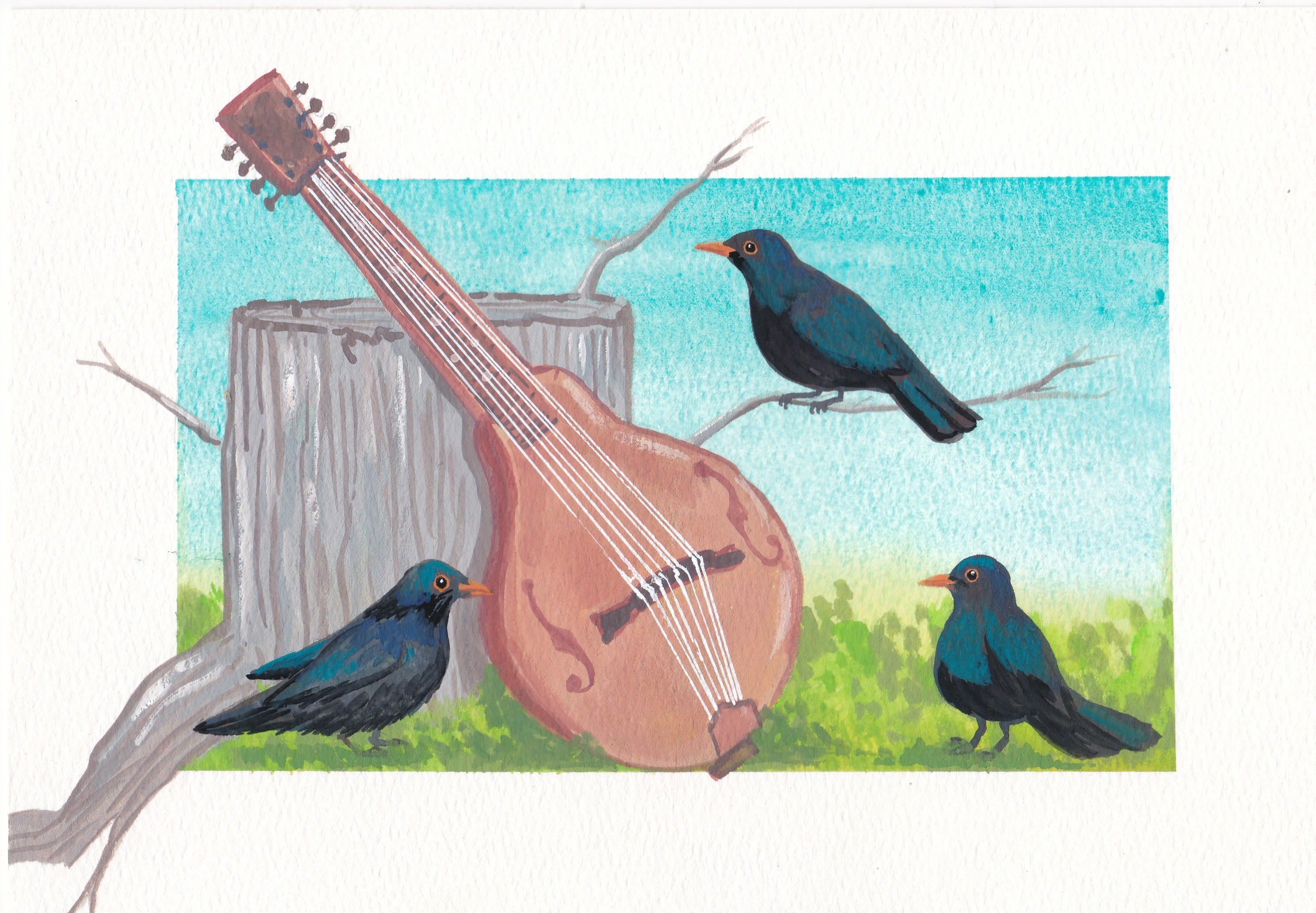
In the place of toucans.The mandoline is the instrument
Of a place.Are there mandolines of western mountains?
Are there mandolines of northern moonlight?The dress of a woman of Lhassa,
In its place,
Is an invisible element of that place
Made visible.
Harmonium is not all existential struggle. Far from it. Even in his ennui he’s playful. Louis Untermeyer called him “childish.” Gorham Munson dubbed him “a dandy.” That stuck. Twenty years later Yvor Winters argued that dandy didn’t cover it. He suggested “hedonist.” I think Stevens was funny.
from Thirteen Ways of Looking at a Blackbird
II
I was of three minds,
Like a tree
In which there are three blackbirds.
“Thirteen Ways of Looking at a Blackbird” is just that. Some were funny, like the above. Some flippant. Others sublime or reverent. The next is numinous if you went to a thesaurus looking for a synonym for “sublime” but with a shade towards mystery.
VIII
I know noble accents
And lucid, inescapable rhythms;
But I know, too,
That the blackbird is involved
In what I know.
He loved to mention birds; palm trees too, but birds. There are peacocks, grackles, toucans, hawks, falcons, and flamingos. Obviously, blackbirds. That’s from a quick flip back through. There are more. He gets on a phoenix kick in his later work, but not yet in Harmonium. I have no idea what the code breakers make of all that.
There is no resolution to his predicament at the end of the book. He doesn’t know how to go forward. He eventually figured out a path, but whether he went back to writing having resolved his dilemma or having made peace with its nagging, I don’t know.
Stevens ends Harmonium with his mind set one way, a moment later set another, and again.
The Wind Shifts
This is how the wind shifts:
Like the thoughts of an old human,
Who still thinks eagerly
And despairingly.
The wind shifts like this:
Like a human without illusions,
Who still feels irrational things within her.
The wind shifts like this:
Like humans approaching proudly,
Like humans approaching angrily.
This is how the wind shifts:
Like a human, heavy and heavy,
Who does not care.
[This entry is cross posted at ordinary-times.com]