

The work week’s nearly over; barely a few hours left. What are you doing? You’re not getting anything done between now and quitting time. Cut out and stop pretending. Piss Off Early, Tomorrow’s Saturday.
First, a little verse.
***
Maxwell Bodenheim didn’t end well. There’s a sense in here and there bios that he was doing just fine, a near toast of a borough, and then things went south. That’s not quite right. He started south. Somewhere in between, he made a name of himself. That there was a high point is tribute to his talents, and given my assessment, the disposition of time allowing for his inconsistent deployment of those talents. He wasn’t a good guy: cantankerous, woman beating, and salacious. That last I forgive.
Maxwell Bodenheim didn’t begin well. He was born in Hermanville, Mississippi, far left of geographical state center, about where Louisiana’s laces would droop, but not near enough the river to expect growth. It was a timber yard with a railroad stop and an Episcopal church. His family moved to Chicago when he was seven or eight where he discovered and delighted in trouble.
Booted from high school, he joined the army, punched an officer, went AWOL, and spent a year in military prison. Once out, he did some migrant work before heading back to Chicago. I’m not sure when he started writing poetry, but around this time he got noticed. His work was picked up by Poetry, included in anthologies with big names like TS Eliot, William Carlos Williams, and Marianne Moore, palled around with writers Ben Hecht and Sherwood Anderson, and pinned his name to the eruption of artistic energy known as the Chicago Renaissance.
In the mid 1920s he moved to New York, Greenwich Village in particular. Sometime in his late teens or early twenties he picked up the nickname “Bogey.” As a New Yorker, he dubbed himself “The King of Greenwich Village Bohemians.” There was no recreation or shedding of his past on taking a new title. He was an ass as Bogey and kept on being an ass as Bohemian Royalty. Wikipedia preserves a quote from a 2012 John Strausbaugh Chisler article where the critic writes of Bodenheim’s “haughty, insulting demeanor, and his habit of trying to steal other men’s women right under their noses, got him regularly socked on the jaw and thrown out of bars, soirees and the fauxhemian revels at Webster Hall.”
He fell in love with Minna Schein with whom he had a son and bopped around Chicago, New York, England, and Hollywood. Whether he stole her and got socked for his trouble, I don’t know, but the couple married in 1918. That same year Minna and Myself, his first book of poetry and the one from which all of this week’s selections come, was published. He’d publish eight more plus an anthology and I suppose I should slip in that wrote thirteen novels as well. This early poetry is uneven.
Here are the first two numbered stanzas from the opening poem.
from Minna
Maxwell Bodenheim (1892-1954)I
Twilight pushes down your eyes
With shimmering, pregnant fingers
That leave you covered with still-born touch.
With little whips of dead words
Silence cuts your lips to a keener red.
Your heart strikes its bed of dark mirth, in death,
And your hands lie over it, guarding the corpse.
Night will soon whisk away this room
But you are already invisible.II
Your cheeks are spent diminuendos
Sheering into the rose-veiled silence of your lips.
Your eyes are gossamer coquettes
Ringed with the sparkling breath of dead loves.
Your body strays into lanterns of form
Strewing the night within this room….
The light dies; you are still
And spill the frolicing night of your heart
Over the darkness about you, making it pale.
He dives into one metaphor and then another without coming up for air so we have twilight pushing with fingers that are pregnant but have still-born touch. Dead words cut with silence and lips run red and hand protect dead from dark but it doesn’t matter because you’re beyond light. It’s exhausting but impressive if you can pull it off. He comes up winning more often that not, even if it’s tinged by eagerness, as if he’d decided a poet rapid fires imagery and having decided, presses on no matter. There’s not a lot of gear shifting, and when there is, rather than enjoy the moment, I’m exasperated with him for not doing so when he should have at other points.
There are XXVII sections of “Minna,” all a but few of them stand alone stanzas like the above. That length and density make ripe for cliches and recycled poetisms. It’s got a “morning glory face” and its kin, but he generally impresses with, if not originality, original deployment of those cliches even if he speeds—relentlessly—through leaving no opportunity to scrutinize syntax. Not all his metaphors follow logically, but they’re catchy. He not a great poet, but manages more often than not to be enjoyable. On paper.
His novel Replenishing Jessica made headlines as far off as France and Britain. He and his publisher were hit with an obscenity charge that the government couldn’t make stick, so he carried danger as an upsetter and panache as a giant slayer. Bodenheim attracted ardent female fans. One cast-off tried suicide. A second succeeded. A third succeeded and blessed the yellow press by being found with Bodenheim’s picture in her hand. A fourth was killed in a subway accident. Melpomene or Thalia, tragedy or comedy, decreed the love letters he’d written to her be scattered about the train car. Bogey was solid copy. He and Minna didn’t divorce until 1938, so this all happened with her suffering (I assume) at home.
He could be charming.
Change
I came upon a maiden
Blowing rose petals in the air
And catching them, as they fell,
Upon quick fingertips
Her laugh fell lighter than the petals
And dropped little gestures upon my forehead.
I gave her sadness and she blew it up
As she had blown the rose petals:
And it almost seemed joy as her fingers caught it.
But I was only a wanderer plaited with dust,
Who gave her new petals to play with.
I haven’t seen any accusations that he beat any of his three wives other than the last. She prostituted herself and he didn’t like that. I accept that there’s a time in every wife beater’s career when he first lands a punch, but think it’s fair to assume if he hit one, he probably hit the others.
After Jazz age fame Bodenheim became a sot, drenched in alcoholism and reduced to selling scribbled poems for drinks. There’s a sub-genre of anecdote where literary minded sorts pass through Greenwich Village, get annoyed by a transient in a bar, and after telling the guy off are remonstrated by locals: “Do you have any idea who that was?” He was already begging when he met his second wife, Grace. His last novel came out in 1933 and he didn’t publish a bound collection of poetry between 1930 and 1942. There’s mention of odd jobs and inconsistent publication in magazines and newspapers, inclusion in a few anti-fascist and socialist anthologies, but his primary occupation seems to have been stringing drinks together as best he could, all the while insisting on his dignity, his defiance, and refusal to “bootlick.”
After Grace suffered with cancer and died, he met and married Ruth. She was nearly thirty years younger than he was so probably more adaptable to living in parks and flophouses as they did. She, as mentioned, brought in old fashioned money while he panhandled and scribbled. One inspired innovation: he’d sit on a sidewalk with a sign that said “Blind” around his neck.
This next poem was written in 1918, so he’s not referencing his blind beggar scam. It doesn’t carry any foreshadowing, qualify as a coincidence, or rise to irony. Seeing it knowing what he’d come to pokes at me, makes me wonder about when paths diverge and whether we are all of what we do or are we what we are when we are. That ponderousness is nearly supported by the text. Meta is as something else does.
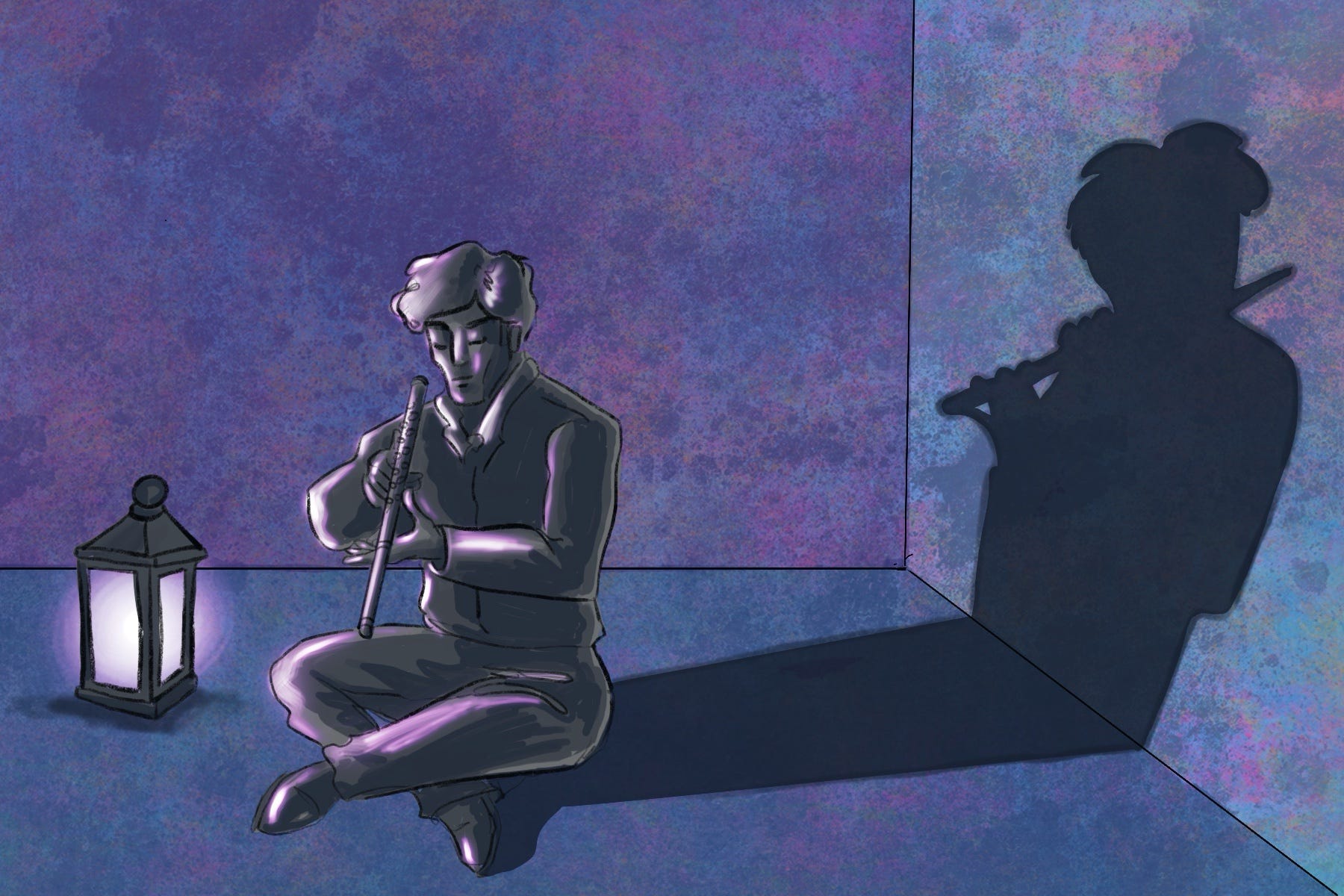
Blind
Blinder than oak-trees in the wind
Endlessly weaving sighs into a poem
To sight,
He sits, the light of one pale purple lantern
Seeping into his dream-hollowed face,
Like floating, transparent words
Pale with unuttered meanings.
He mends a flute and sighs as though
Its shadow leaned heavily upon his heart
And told him things his dead eyes could not grasp.
Another poem that’s poignant in retrospect.
Poet-Vagabond Grown
The dust of many roads has been my grey wine.
Surprised beech-trees have bowed
With me, to the plodding morning
Humming tunes frail as webs of dead perfume,
To his love in golden silks, the departed moon.
Maidens like rose-flooded statues
Have bathed me in the wine of their silence.But now I walk on, alone.
And only after watching many evenings,
Do I dance a bit with dying wisps of moon-light,
To persuade myself that I am young.
In 1954, he and Ruth made friends with a dishwasher named Charlie Weinberg, who let them spend a night in his apartment. Bodenheim woke up to find either Ruth and Charlie having sex or Charlie raping Ruth. Regardless of which, he objected and consequently was shot and killed by Weinberg who turned on Ruth and stabbed her repeatedly until she died. “I ought to get a medal,” he later said. “I killed two communists.”
His poetry changed over time. The short declaritories of Minna and Myself gave way to longer spindly poems, tetrameter to the eye but lacking meter, single columned free verse indented after short jabs. I don’t have access to any of his vagrant work, but Paul Maher Jr., in his 2019 Please Kill Me article about a 1951 meeting between Bondenheim and Jack Kerouac, writes of Bondenheim,
“He saw no beauty sufficient enough to distill into sonnet form. ‘[B]eauty,’ he explained to Hecht, ‘has become a wounded ignored vagabond; truth dodges wearily through a host of figures pretending to be truth; and imagination is a ghost flirting with tantalizing memories.’”
I can’t help but imagine they were bleak.
Tough Poets Press is making a go of reviving interest in the guy with reprints of a couple of novels and a collection of essays. Project Gutenberg has a few of his works available, but that’s museum curation. He’s largely forgotten. His son, possibly in part out of deserved pique at being named Solbert, kept a distance, was embarrassed by his father’s Bohemian life and disastrous reputation, and died six years after Maxwell.
There’s not much left. He a had a talent for image and metaphor that, with a little discipline, could have made something memorable. Instead, he drank and pissed it all away. Didn’t even get a Mickey Rourke movie out of it.
Death
I shall walk down the road.
I shall turn and feel upon my feet
The kisses of Death, like scented rain.
For Death is a black slave with little silver birds
Perched in a sleeping wreath upon his head.
He will tell me, his voice like jewels
Dropped into a satin bag,
How he has tip-toed after me down the road,
His heart made a dark whirlpool with longing for me.
Then he will graze me with his hands
And I shall be one of the sleeping, silver birds
Between the cold waves of his hair, as he tip-toes on.
[This entry is cross posted at ordinary-times.com]