

In the summer of 1818, John Keats and his friend Charles Armitage Brown went on a walking tour of Scotland. It looks like the pair covered somewhere between six hundred to six hundred and fifty miles over forty-four days, so about fifteen miles a day, give or take and accounting for weather.
Keats wrote a series of letters about the journey to his consumptive brother Thomas, unable to travel with what they didn’t know at the time was his last bout with tuberculosis. He brings his brother along in these letters. It’s endearing. He’s colloquial and considerate. Reading, you get the sense he really did “Wish you were here.” You also get the sense that he was entertaining a bedridden friend, and further, the sense that his audience enjoyed laughing at small frustrations.
There’s a great deal about lovely views, divine salt water baths, and all the joys that make for good travel brouchuring, but Keats peppers it with amusing observations; little asides he would give were Thomas along.
He and Brown came upon the Duke of Argyle’s “modern magnificent” seat on a day when a band played, a little serendipity adding music to the grey stone Inverary Castle by “lovely” Loch Fyne and surrounding dark, old woods. To Thomas:
“I must say I enjoyed two or three common tunes—but nothing could stifle the horrors of a solo on the Bag-pipe—I thought the Beast would never have done.—Yet was I doomed to hear another.”
There were rough nights and coarse meals; all the minor bitches travelers log. I was very glad to read they took a long road miles out of their way rather than pay what they considered an unfair toll for the comparison Keats made.
“—but the expense is 7 Guineas and those rather extorted.—Staffa you see is a fashionable place and therefore every one concerned with it either in this town or the Island are what you call up. ’Tis like paying sixpence for an apple at the playhouse.”
Or $22.39 for a popcorn bucket at an AMC. Some things never change.
What I believe to be the first letter to Thomas from tour, dated July 17, 1818, recounts steam boats, purple mountains, pink clouds, a deceptive sign promising breakfast without informing that said breakfast was fifteen miles away, and the banks of the Clyde. Almost perfect:
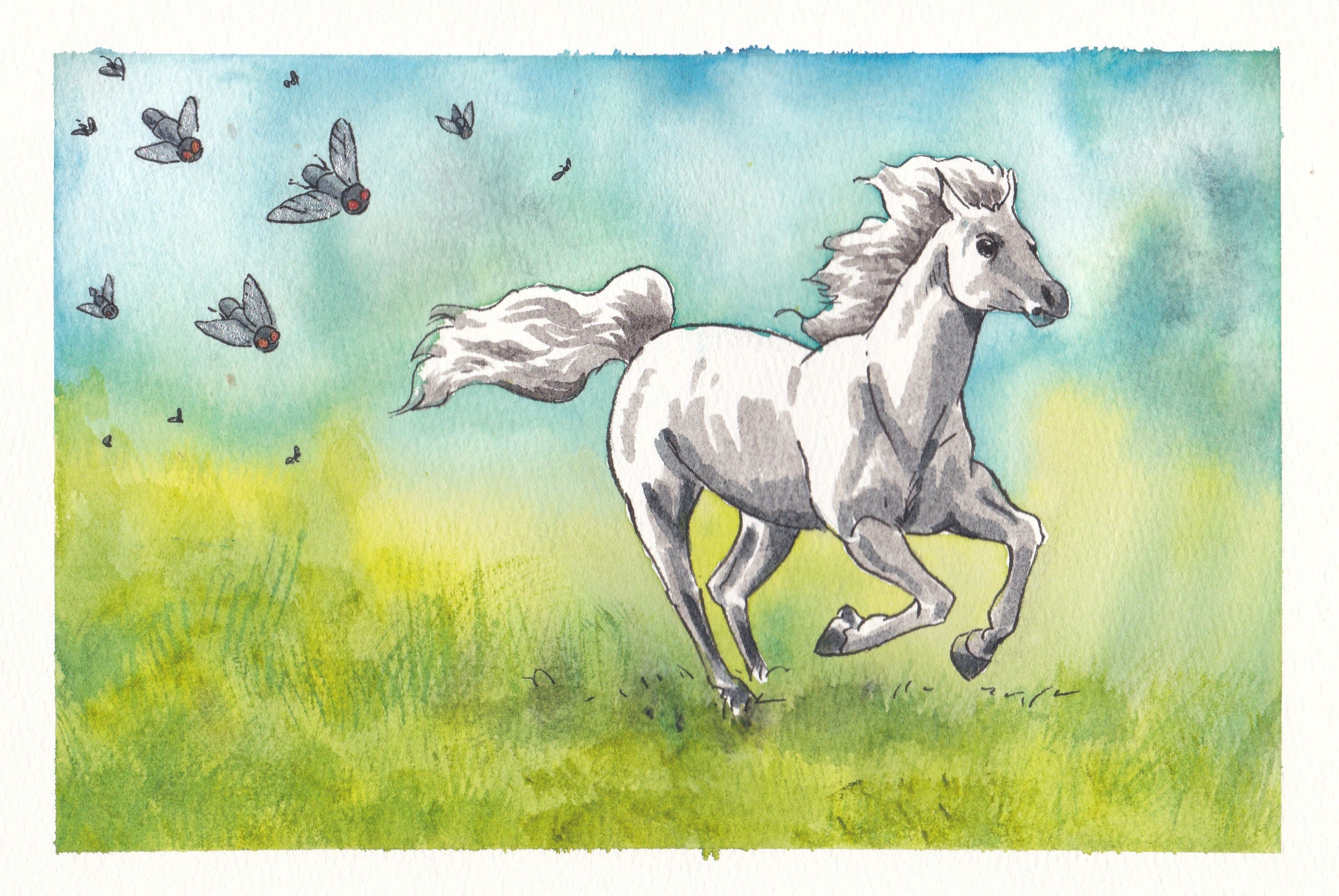
“—I have just been bathing in Loch Fyne a salt water Lake opposite the Windows,—quite pat and fresh but for the cursed Gad flies—damn ’em they have been at me ever since I left the Swan and two necks.”1
After that line, he offers a fourteen stanza poem. It’s doggerel and unpolished, but suited to bring a smile to a bedridden brother. There was no title. Where it appears it is often given the working title “Gadfly.”
Gadfly
John Keats (1795-1821)All gentle folks who owe a grudge
To any living thing
Open your ears and stay your trudge
Whilst I in dudgeon sing.The Gadfly he hath stung me sore—
O may he ne’er sting you!
But we have many a horrid bore
He may sting black and blue.Has any here an old grey Mare
With three legs all her store,
O put it to her Buttocks bare
And straight she’ll run on four.
So far, good fun. He gets mean in the next section. As to why, I need help.
In The Birth of the Modern: World Society 1850-1830, Paul Johnson writes about “one of the most memorable dinner parties in the history of English literature.” The party itself doesn’t seem all that memorable to me. There’s drunken foolishness, it’s peopled with luminaries, and there’s some awkwardness made more awkward by the mentioned drunken foolishness, but there’s nothing epochal in the telling. The telling itself is interesting. Johnson contrasts how Keats relays the story immediately and then months after.
On December 28, 1817, Keats met William Wordsworth for the first time. The older poet was visiting London and the painter Benjamin Robert Haydon was keen to introduce the young up and coming poet to the great man. Both were invited to dinner, along with Charles Lamb and Thomas Monkhouse, a merchant and cousin of Wordsworth’s wife Mary. Others joined as the day went on: an engraver named Landseer and Joseph Ritchie, famous for his travels. They discussed Voltaire, toasted Newton, and recited Milton. Good times.
At the time, Wordsworth was under appointment from his landlord and friend William Lowther, second Earl of Lonsdale, as Collector of Stamps for Westmoreland, a job Johnson notes, “was by no means a sinecure.” He earned roughly £200 a year, but there was a great deal of work to be done. His duties put him in frequent correspondence with his superior, John Kingston, Commissioner of Stamp Duties in London, a fan. Kingston heard of the dinner, knew Haydon, and asked if the painter might make him an in person introduction to Wordsworth. Haydon agreed and Kingston was set to come join the group after dinner, which I take to mean lunch as it’s mentioned the gathering continued into supper.
Lamb got obliterated. In a letter to his brothers George and Thomas, Keats singles him out as “tipsy,” but he’s soft-pedaling. Kingston didn’t fit in. He was in over his head trying to join the conversation. Johnson says he asked Wordsworth if he thought Milton was a genius. It was a stupid question, given the company—like asking a bunch of football coaches if they found the forward pass useful—but he asked from respect and interest. Lamb called him a “silly fellow” and asked “will you allow me to look at your phrenological development?”
At this point, Wordsworth had been introduced to Kingston but without honorifics, so hadn’t connected that this Kingston was the Kingston, Lord of All Postage, for whom he worked. When Kingston told Wordsworth that he’d enjoyed their correspondence, Wordsworth was at a loss. “With me, sir?” he asked. There was some confused back and forth until Kingston made clear, “I am the Commissioner of Stamps.” Johnson writes,
“There was, said Haydon, ‘a dead silence,’ broken by Lamb’s repeated ‘Do let me have another look at that gentleman’s organs.’ At that point, Haydon recorded, ‘Keats and I hurried Lamb into the painting-room, shut the door, and gave way to inextinguishable laughter.’ Kingston was huffy and, at first, ‘Irreconcilable,’ and Wordsworth had to humor him as best he could. But he was persuaded to stay to supper, during which, at intervals, could be heard Lamb’s voice from the next room: ‘Who is that fellow? Allow me to see his organs once more.’”
That’s the story as it comes to us from Haydon. In a letter to George and Thomas a week after the Sunday dinner, Keats gives the briefest coverage: there was a dinner, Lamb was tipsy, here’s who was there. He tells his brothers that he and Wordsworth made plans for lunch the next Thursday but weather was an issue. All seemed well between the two.
By mid-summer, Wordsworth was fodder for quick jotted mocking.
Has any here a Lawyer suit
Of Seventeen-Forty-Three,
Take Lawyer’s nose and put it to ‘t
And you the end will see.Is there a Man in Parliament
Dum[b-] founder’d in his speech,
O let his neighbour make a rent
And put one in his breech.O Lowther how much better thou
Hadst figur’d t’other day
When to the folks thou mad’st a bow
And hadst no more to say.If lucky Gadfly had but ta’en
His seat upon thine A—e
And put thee to a little pain
To save thee from a worse.Better than Southey it had been,
Better than Mr. D—,
Better than Wordsworth too, I ween,
Better than Mr. V—.
If we move forward to February 21, 1818, we find another mention of Wordsworth in a letter to George and Thomas. It’s a roundup letter: Sorry I haven’t written lately, went to the British Gallery, Haydon’s essays are in translation to Italian, Reynolds got a leech treatment, thrushes and blackbirds are out, reading Voltaire and Gibbons, new Byron coming out, Ditto new Scott. Then there’s,
“I am sorry that Wordsworth has left a bad impression wherever he visited in town by his egotism, Vanity, and bigotry. Yet he is a great poet if not a philosopher.”
There’s no explanation. It’s unclear whether Wordsworth offended him or if he felt others mistakenly took offense to his manner or deeds. It’s a curious little enigma. On to “have not yet read Shelley’s Poem,” “Your affectionate brother, John.”
Johnson makes no mention of that letter. He skips ahead to an attempt by Keats to visit Wordsworth en route to his summer walking tour with Brown. On June 27, he asks about Wordsworth of a waiter at his hotel and is told that the poet is off canvasing the countryside on behalf of his friend the Earl’s family members, the Lowthers, due for election. Keats is offended. A Romantic poet, any poet, is above politics. Wordsworth is betraying a spirit. He was already suspect as holder of a government position, but he was electioneering. He rained down on Robert Southey in the Gadfly poem for holding a position in government too, even though that position was Poet Laureate. How much more vulgar must Wordsworth pressing hands seem?
He makes a call at the Wordsworths’ the next day, but has to settle for leaving a note “and stuck it up over what I knew must be [Dorothy] Wordsworth’s portrait.” There doesn’t seem to be any record of what the note contained. I think I’m supposed to infer a sneer in placing the note on Dorothy’s portrait. I’m not certain why. He fired off a “Lord Wordsworth” letter to Thomas right away.
He also told a different version of the dinner going forward. In the knew telling, Wordsworth was obsequious towards Kingston, a toady ignoring or brushing away the other guests. Keats either let anger warp memory or embraced a soothing slander. The poem letter came after some time to ruminate.
Again, from Johnson:
“Three weeks later, still disgusted by Wordsworth’s flaunting of the radical orthodoxy, he wrote a set of vulgar verses, much concerned with buttocks and arses, mocking Wordsworth, Southey, the Lowthers and, for good measure, the Chancellor of the Exchequer, Nicholas Vandittart.”
After he got a few angry stanzas out of his system, it’s back to standards: making fun of girls who read too many novels—the “What is up with airplane food?” of 1818.
Forgive me pray good people all
For deviating so—
In spirit sure I had a call—
And now I on will go.Has any here a daughter fair
Too fond of reading novels,
Too apt to fall in love with care
And charming Mister Lovels,O put a Gadfly to that thing
She keeps so white and pert—
I mean the finger for the ring,
And it will breed a wort.Has any here a pious spouse
Who seven times a day
Scolds as King David pray’d, to chouse
And have her holy way—O let a Gadfly’s little sting
Persuade her sacred tongue
That noises are a common thing,
But that her bell has rung.And as this is the summon bo-
num of all conquering,
I leave withouten wordes mo
The Gadfly’s little sting.
“The first point to be grasped,” Johnson tells us, “is that the romantic movement produced heightened sensibilities, felt (even if unconsciously) at every level of society.” Johnson’s a brilliant historian, so when he goes on to say that the early 1800s saw a sudden awakening to income inequality, a keen sympathy for the impoverished, and a disgust at resignation regarding both, I believe him.
“...it is necessary to pause and examine why it is that John Keats, not a man much interested in politics, rather one who reflected the prevailing notions of his friends, should feel so depressed by Wordsworth’s allegiance and why the latter should have committed himself so wholeheartedly to upholding the government. Why did these poets of different generations—Wordsworth was now 48—but of similar sensibilities… find themselves on opposite sides of the great political divide which then severed Britain and indeed the whole of Europe?”
His interest is in cultural shifts. He needs to see everything in light of a larger picture. I’m nosy. I want the smaller story. What elicited the “egotism, Vanity, and bigotry” claim?
[This entry is cross posted at ordinary-times.com]
I found a nugget in a William Logan essay called “Dickinson’s Nothings” about em dashes. The mark is so identified with Emily Dickinson that people jokingly call them “Emily dashes.” Per Logan, they were a common feature of handwritten work in the past. Logan writes, “Even as late as Dickinson’s day, authors did not always care to govern their stops, which could be left to the drudges of the printing house, as had been done before Shakespeare.” The Keats letters are rife with the things. I’ve found corroborating sources. Logan’s right, but this is the first time I’ve noticed an abundance of dashes, presumably in an un-drudge-fiddled-with source. When I say “em-dash,” I’m actually saying “Em-dash” because I’m thinking “Emily-dash,” even though she probably didn’t give them a second’s thought. I leave withouten wordes mo.