

I just got an email from my son’s college informing parents that our little darlings have to be out of the dorms by May, 9. That went quickly. Tempis fugit, carpe diem, “Life moves pretty fast. If you don’t stop and look around once in a while, you could miss it,” Piss Off Early, Tomorrow’s Saturday.
Honestly, that really snuck up on me. Freshman year: Almost down.
In the mean time, do that last one. Happy POETS Day.
First, a little verse.
***
I read about poets lives a good deal, and have decided that a lot of literary immortality is born from not having any idea what you’re doing on any front—politics, relationships, plain ole human decency—and making a ton of noise while you try to figure it out.
Not all, but many. Mild mannered insurance agent Wallace Stevens threw a punch at Hemingway. Pound blathered on about passports, clothing drives, new, new, new, and economic fantasy. The upright TS Eliot kept well within the rails when not tearing hundreds year old poetic tradition to pieces and filling the void with continuum-compliant fixes. He may have been the messiest of the lot. It’s seamless energy. Even in tubercular throes, Keats, Dunbar, Praed, and Lawrence produced poetry, sent out letters, remained exhibitionist observers. From one thing to another, promiscuous passions, stardom, hermitage; there is either a singularity of focus in the moment frequent to literary success or a conspiracy of biographers leading me to believe so. And the energy needs focus. One thing succeeds, fails, or finishes. What’s next?
The great Scottish poet Hugh MacDiarmid was a fascist in the 1920s when everybody who was a loud and proud fascist or a loud and proud anti-fascist thought Roy Campbell was the opposite and got into public spats with him. But MacDiarmid was too much a political gypsy, so left fascism behind for Communism. The local Scots variant wasn’t sufficient and so, having had a taste, moved on to Stalinism. I don’t know the order or the particulars other than that in the 1930s he was kicked out of the Communist Party of Great Britain twice, at least once for being too nationalist, and kicked out of the Scottish Nationalist Party, even as a founding member of its predecessor organization, the National Party of Scotland, for being too communist. Bygones happened somewhere along the line as he stood for Parliament in 1945 under the SNP banner and 1964 as CPGB.
I think it’s wrong to read MacDiarmid as a steady conscience not fitting quite into so bouncing between parties. He was mercurial. In a given span he’s throwing bombs in both directions. One of his biographers, Dr Margery Palmer McCulloch of Glasgow University, is quoted in a 2010 Sunday Times article under the headline “Hugh MacDiarmid: I’d prefer Nazi rule,” as saying “MacDiarmid seemed to just fire off ideas and antagonisms without thinking them through.” His daughter-in-law and literary executor, Deirdre Grieve, is quoted in the same article: “I think he entertained almost every ideal it was possible to entertain at one point or another.” Just Hugh being Hugh.
I came upon something that I had to read twice, do a few searches, and then read those searches twice. George Orwell put MacDiarmid’s name to MI5 as someone to watch for Soviet sympathies. This was in 1949. Orwell was no fan of the Soviets and listed several he feared might be open to giving whatever the British condemnatory equivalent of “aid and comfort” to the enemy is. I don’t know what MacDiarmid was up to, but it’s eyebrow raising to read that the author of 1984 thought a little monitoring prudent.
Once you know a guy is into totalitarian politics, it’s hard to pin anything as his focus. Politics saturates the whole. But, he was a poet. Maybe first and foremost, though a nationalist poet who saw his work as a vehicle for a Scottish literary renascence, breaking away from the oppressive English, and elevating the pretty much dead Lallan (Lowland) language. Politics.
The problem, or obstacle, was the indifference of the Scots. There wasn’t a single language to revive so much as a passel of dialects. It was all Creole and no French, with none of the shoots a clear true heir. Poor MacDiarmid had to scrabble together whatever he could from his Lowland upbringing, scour John Jamieson’s Etymological Dictionary of the Scottish Language, and impose familiar (English) grammar on the result. He lived on the island of Whalsey in the Shetlands from 1933 to 1945, and I’m sure he must have made friends who’d give him an honest answer, but per Wikipedia, “Local legend has it that he asked about Whalsay words and some of the Whalsay folk made up fantastical words that did not exist.”
Michael Glover’s “Thistle & thorns” (The New Criterion, March 1994) is one of the more entertaining articles I’ve read on any subject. He takes MacDiarmid down a host of pegs but it’s clear Glover respects the man a great deal as a poet. It’s a kindly takedown, as if he pulled MacDiarmid aside and said “Have you thought about what you’re doing? Do you see how this looks?” From the article:
“The prophet, sad to say, was not honored in his own country. MacDiarmid’s Scots readers, English speakers to a man, were perplexed. Who owned this synthetic language, this tissue of willful obscurities? they asked. And what were they to do with it? MacDiarmid sighed and rent his shirt. For if there was one nation that MacDiarmid had an even greater contempt for than the English, it was undoubtedly his own: that people of his who deemed ‘their ignorance their glory’; who had willingly accepted the terms of slavery that the English had handed down to them; and who had no capacity to think anything other than their own ‘dour provincial thochts.’”
There’s no hatred like that reserved for the most likely ally. Back to politics: Leninists hate Trotskyites hate Stalinists, Right-Libertarians hate Consequitialist Libertarians, Jacobins hate all in time, and Orwell turned in Soviet types. So the Scots earned MacDiarmid’s scorn. More so did those who made a fetish over Robert Burns. To be clear, he loved Burns. But you don’t get Burns. Not like he did.
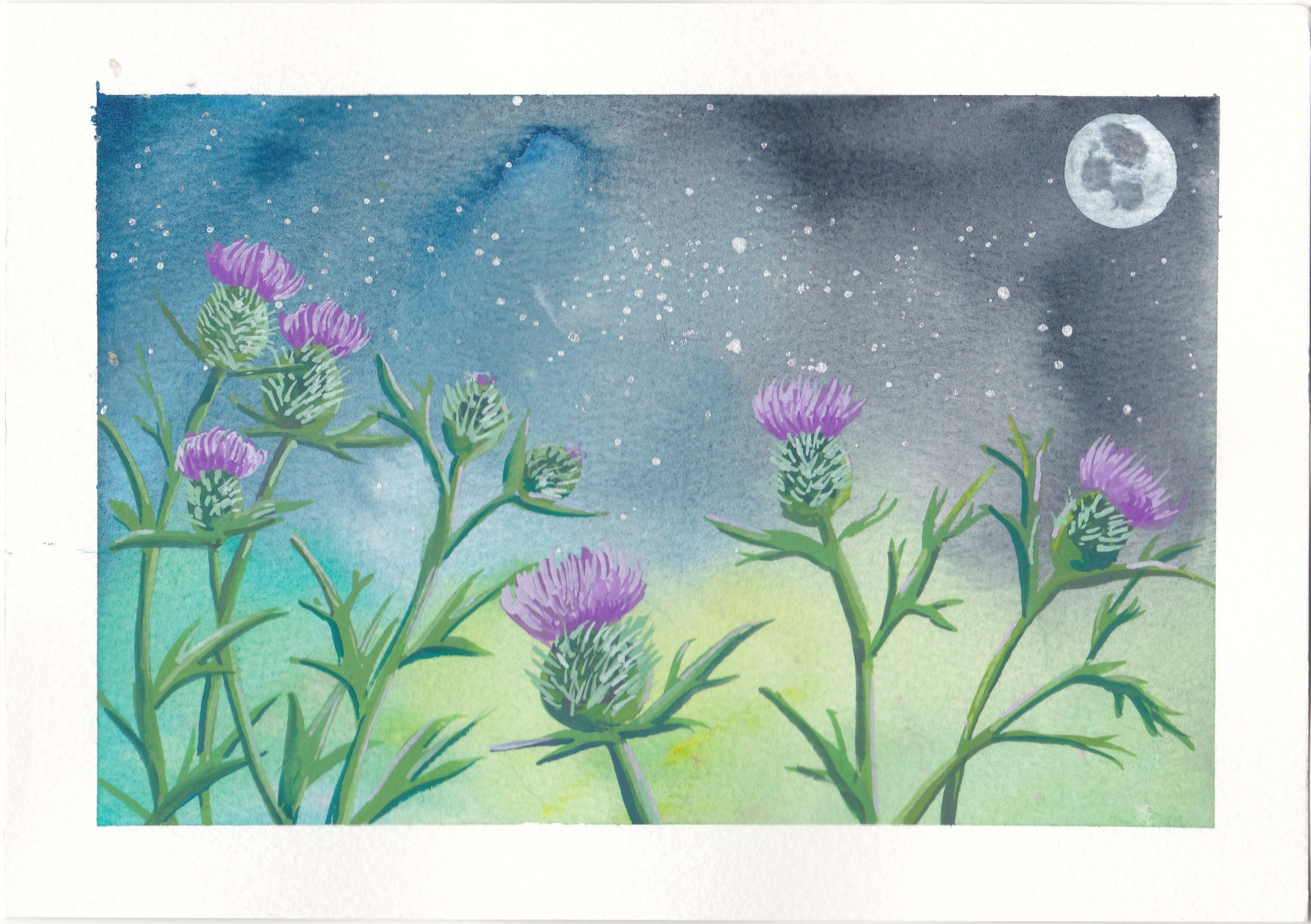
His most famous work is A Drunk Man Looks at the Thistle, a two-thousand six hundred and eighty-five line epic about a man walking home from the pub, thinking about the world. It’s a patchwork of styles and subjects; those ranging from the writings of Nietzsche and Dostoevsky, Isadora Duncan and a union strike, and, all this per Wikipedia, “develops and consciously parodies compositional techniques used by poets such as Ezra Pound and T.S. Eliot.” It’s a well respected and praised work. I’ve read bits here and there. It’s a mess if you try to wring out every meaning. It’s the authors Esperanto so there’s no one reader that gets it without a glossary, but there’s music. There’s no denying the sound.
Here’s an excerpt where he gives what for to Burns fans.
from A Drunk Man Looks at the Thistle
Hugh MacDiarmid (1892-1978)You canna gang to a Burns supper even
Wi’oot some wizened scrunt o’ a knock-knee
Chinee turns roon to say, “Him Haggis—velly goot!”
And ten to wan the piper is a Cockney.No’ wan in fifty kens a wurd Burns wrote
But misapplied is a’body’s property,
And gin there was his like alive the day
They’d be the last a kennin’ haund to gie—Croose London Scotties wi’ their braw shirt fronts
And a’ their fancy freen’s, rejoicin’
That similah gatherings in Timbuctoo,
Bagdad—and Hell, nae doot—are voicin’Burns’ sentiments o’ universal love,
In pidgin’ English or in wild-fowl Scots,
And toastin’ ane wha’s nocht to them but an
Excuse for faitherin’ Genius wi’ their thochts.
His real name was Christopher Murray Grieve. Hugh MacDiarmid was a pen name. For those keeping score, he used a fake name and a fake language, both evoking a nostalgic Scottish tradition, in order to reassert a muscular Scots literature. It’s absurd, but it kinda worked. Again, he was a very talented poet.
It’s possible for all the barbs and pokes of the Glover article to land and for the following, from the excellent unsung biographers who toil at Poetry Foundation, to be true.
“C. M. Grieve, best known under his pseudonym Hugh MacDiarmid, is credited with effecting a Scottish literary revolution which restored an indigenous Scots literature and has been acknowledged as the greatest poet that his country has produced since Robert Burns. As a writer, political theorist, revolutionary, prophet, and multifaceted personality, he was a man to be reckoned with, even by those who did not agree that he was one of Great Britain’s major poets. Ian Hamilton wrote that MacDiarmid made enemies largely because ‘he makes his own rules, contemns categories, cracks open water-tight compartments, bestraddles disciplines, scorns social, cultural, and academic cliques and claques, and affirms . . . that it is not failure but low aim that is criminal.’”
Once more for those keeping score, that’s “prophet” twice, and from different sources.
The Norton Anthology of the English Language, Vol II, footnotes an explanation for the next poem.
“This is one of a series of four lyrics titles Au Clair de la Lune (“By the light of the moon”). MacDiarmid has written of it: ‘The first two lines of “Moonstruck” mean: “When the world is dozed like a top at the height of its spin, that the light-looking crow of a body, the moon…” I can think of no English equivalent which can bring out the complicated sense of that description of the moon, at once insubstantial and disreputable looking, radiant and yet dark with sinister influences.”
It also has a footnote defining “peerieweerie” as “Diminished to a mere thread of sound.” I am charmed and will be using the word.
Moonstruck
When the warl’s couped soon’ as a peerie
That licht-lookin’ craw o’ a body, the moon,
Sits on the fower cross-win’s
Peerin’ a’ roon’.She’s seen me—she’s seen me—an’ straucht
Loupit clean on the quick o’my hert.
The quhither o’ cauld gowd’s fairly
Gi’en me a stert.An’ the roarin’ o’ oceans noo’
Is peerieweerie to me:
Thunner’s a tinklin’ bell: an’ Time
Whud’s like a flee.
MacDiarmid butted heads frequently and publicly with Edwin Muir who believed that if Scotland were to have a national literature, it should be English, as speakers of almost every dialect knew English as well, to one degree or another. His 1938 Scott and Scotland drew ire from most quarters, but he was right that if there was a commonality to be expressed, the language was secondary to expressing it and English was already in place for the Scots. Glover is frank on the point:
“…the humiliations suffered by the native languages of Scotland…began in earnest much earlier; earlier even than the uniting of the two crowns of England and Scotland in 1603.”
The Geneva Bible was the Bible of service in Scotland since 1579. It was translated into English, not Scots. When James I united the crown, he moved his court South. Court and church were creatures of the English language, and Scots in all its forms diminished.
In addition to Muir, MacDiarmid found new ground for battling Campbell; their Fascist dyspepsia launched a new conflict over MacDiarmid’s brand of Lallans he dubbed “Synthetic Scots.” Campbell was having none of it. He was born in South Africa, but to Scottish parents and carried second generation zeal for the old country. To him, the manufacturing was too much to overlook. There’s a poem Campbell wrote to mock the whole endeavour, but I can’t find a single stanza online or at the library. From the title, I suspect it’s amazing: “Ska-hawtch Wha Hae! A Likkle wee poom i’th’ Aulde Teashoppe Pidgin Brogue, Lallands or Butter-Scotch (Wi’ apooligees to MockDiarmid).”
MacDiarmid carried on the fight until one day he didn’t. He may have been unable to think of an “English equivalent which can bring out the complicated sense of that description of the moon,” but he was having trouble with everything else. For all his passion and the aid of the Jamieson Dictionary, the assembled Scots vocabulary was too small. It was limiting. So he started writing in English.
I can find no recorded apostasy. One day he railed against those who didn’t join his crusade, the next he abandoned it. I can’t find anything from Muir’ side either, though I’m sure there must have been something written somewhere. Maybe they thought, “Take the win.” He joined their side, no point in berating him for agreeing.
A last from Glover:
“And, true to his own estimation, that vituperative nature which held him in its thrall also caused him to give birth to much that was clumsy, ugly, ill-formed; to be silly, pedantic, naïve, and absurdly pretentious. And yet, amidst all this bluster, there is still some great poetry to be reckoned with.”
From Fascist, to damn Hitler, to at least the Nazis aren’t English, from preserving a heritage, to embracing a broader expression. All on a dime and all full steam. He’s a tremendous English poet for a rebellious Scot.
In the Children’s Hospital
“Does it matter? Losing your legs?”
Siegfried SassoonNow let the legless boy show the great lady
How well he can manage his crutches.
It doesn’t matter though the Sister objects,
“He’s not used to them yet,” when such is
The will of the Princess. Come, Tommy,
Try a few desperate steps through the ward.
Then the hand of Royalty will pat your head
And life suddenly cease to be hard.
For a couple of legs are surely no miss
When the loss leads to such an honour as this!
One knows, when one sees how jealous the rest
Of the children are, it’s been all for the best!—
But would the sound of your sticks on the floor
Thundered in her skull for evermore!
[This entry is cross posted at ordinary-times.com]