

For those who care about golf, this is your time. The Masters and its NPR whisper-excitement for four televised days is a duck out of work away. For those who don’t care about golf, it’s going to be a pain in the ass getting a table at the neighborhood joint. My local sods the dining room and patio, props azaleas in all the corners, pulls in an under-armor collared shirt Hootie type band for post-round, and makes it damn near impossible for a regular to eat a club sandwich in peace. People in green and white holding red solo cups spill out into the parking lot. They pack the place and good for them, I guess.
Happy POETS Day. Piss Off Early, Tomorrow’s Saturday. I hope your golf team wins.
First: verse.
***
In his younger years, George William Russell had a vision. Details of the vision are unclear to me, but “Aeon”, a Gnostic word meaning early being or ancient cosmic intelligence, popped from the fringe of understanding and held court, nipping at his synapses. He claims to have never heard the word before and to have been ignorant of its meaning until revelation fixed it front and conscious center. Obviously, he looked it up. Obviously it had meaning and implications. He decided Aeon would be his non de plume.
Something got confused. A printer was buffaloed by Russell’s use of the ash, or “Æ” character, to spell Æon. There doesn’t appear to be an academic reason for the ash. I can’t find support for using the symbol in aeon though there was a fashion for dressing up Latin and Greek terms with it as flourish in the late 19th and early 20th centuries whether called for or not. There were heavy metal album cover designers before there were heavy metal albums, so it’s possible Russell spelled for an esoteric aesthetic.
For whatever reason, he used it and the printer didn’t pick up on what he laid down. To the printer’s defense, Russell’s handwriting was notably atrocious. He’s lucky to have deciphered the hieroglyph as resembling A and E at all. The result was a work credited to an author named AE. Russell liked AE and kept it.
A few of you may remember weeks’ back when I wrote about DH Lawrence. I took a tangent to regret having regularly written T.S. Eliot now that a decorative turn had me preferring TS Eliot. C.S. Lewis suddenly looked dated compared to CS Lewis; like a double space after a full-stop, a flouncy handkerchief in a Wall Street pocket-square law firm. Sometimes, AE would sign A.E. and sometimes, AE. With frequency, he signed poems and paintings as Æ. A.E. is old and staid. Æ is an affectation. I applaud circumstances that confer on AE a middle of the road, moderate, common sense mantle.
The periods had their A.E. moment. James Joyce paid homage to Russell with a cameo, or the literary equivalent, in Ulysses. Fictional Russell objects to Stephen Dedalus’s delving into Shakespeare’s life to enlighten the plays. Russell’s having none of it:
—But this prying into the family life of a great man, Russell began impatiently.
Art thou there, truepenny?
—Interesting only to the parish clerk. I mean, we have the plays. I mean when we read the poetry of King Lear what is it to us how the poet lived? As for living our servants can do that for us, Villiers de l’Isle has said. Peeping and prying into greenroom gossip of the day, the poet’s drinking, the poet’s debts. We have King Lear: and it is immortal.
Immediately after the conversation Dedalus is reminded that he owes Russell a pound, so the pun happy Joyce has him say “A.E.I.O.U.”
I wonder at the conversation. Russæll shared a long friendship with W.B. Yeats, though the two were said to be contentious. Did Joyce allude to frequent intellectual splits between Yeats and Russell with his fictional Shakespeare debate? Was he acknowledging a broader penchant for verbal sword crossing during the Modern Period’s Irish Literary Revival? Was he singling out Russell as particularly argumentative? Russell certainly entertained game discussion on all manner of subjects.
Oliver St John Gogarty, short list candidate for wittiest man no longer alive, wrote of Russell’s famous salon-casuals at 17 Ruthgar Avenue in Dublin, coined “At Home Sundays” by the host. Gogarty wrote a semi-fiction work, “neither a ‘memoir’ nor a novel” by the author’s telling, called As I Was Going Down Sackville Street: A Phantasy of Fact. Real life figures like Joyce, Yeats, and Micheal Collins pop in and out and interact with fictions. In one scene he—fictionalized Gogarty—tries to explain to a pair of American girls the honor they’d just received on being invited to an At Home Sunday.
“To explain my meaning, I want you to think of this house of [Russell’s] as a house for artists, and not for lecturers, readers, preachers, teachers, or people with points. It has been said of Æ that he is one of those rare spirits who brings us a realization of our own divinity and intensify [sic] it. He enlarges the joy that is hidden in the heroic heart. He is a magnifier of the moods of the soul; and he communicates them more naturally by music and murmuring song than by messages or points. Don’t forget what Robert Louis Stevenson said about geniuses like Æ. ‘Such are the best teachers. A spirit communicated is a perpetual possession. Those best teachers climb beyond teaching to the plane of art. It is themselves, and, what is more, the best in themselves, that they communicate.” That is the secret of Æ. He is an artist. He teaches nothing. He communicates himself, and the best in himself, which consists of poetry, loving kindness, and a passion for beauty more than for anything else. So you see he is far more like Plato than like the Tolstoi whom I saw that his appearance suggested to you at first sight.”
By “The Tolstoi,” as he referred to Æ at least a couple of times in the book, Gogarty needled the man for his formidable beard, very serious rifle sight of a nose, and pince nez/flat-line brow combination framed by often longish wavy hair. Gogarty didn’t agree with Russell all that often, but they got along famously.
Yeats had his own salon on Mondays. Yeats attended Russell’s and Russell attended Yeats’s. In fact, the same luminaries attended both but the character of the gatherings were different, reflecting the temperament of the host. 17 Ruthgar was egalitarian and free spirited debate was encouraged. Yeats’s was appreciative. Almost aristocratic. Trends and merits were discussed at Russell’s. Yeats presented what he’d already decided was worthy of attention.
Russell was a devotee of Helen Blavatsky’s Theosophy religion, of which followers insist is not a religion. Blavatsky began her movement in New York in the late 19th century. Anyone who’s read Charles Portis’s Masters of Atlantis will note that much of the book’s fictional Gnomon Society echos Theosophical lore: secret masters, lost knowledge. Hers was a synthesis of Eastern religion and European philosophy. There were mysteries and an elite. Members were privy where others were not. I say “were privy.” There remain enough current adherents to slightly more than sell out a Montreal Canadiens home game.
New York
George William Russell (1867-1935)With these heaven-assailing spires
All that was in clay or stone
Fabled of rich Babylon
By these children is outdone.Earth has split her fire in these
To make them of her mightier kind;
Has she that precious fire to give,
The starry-pointing Magian mind,That soared from the Chaldean plains
Through zones of mystic air, and found
The Master of the Zodiac,
The Will that makes the Wheel go round?
Russell remained a Theosophist for life. He was joined by Yeats for a brief while. The two collaborated on murals decorating the Dublin Theosophical Society where Russell kept a room for a few years, but Yeats caused trouble. There were occult practices forbidden by the non-religion and he pracriced them anyway. In 1890, Yeats was excommunicated. Again, a point of contention: mysticism vs magic.
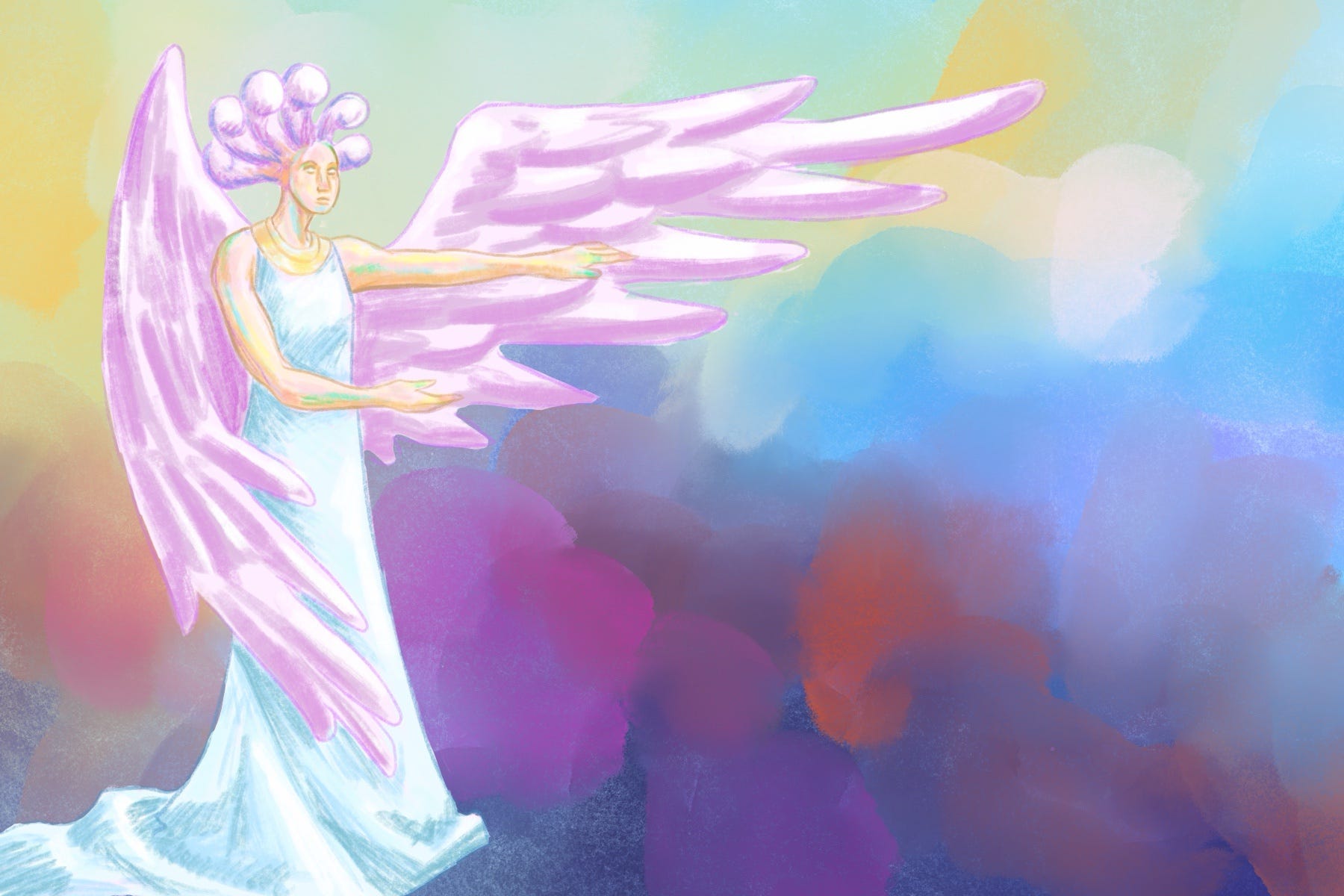
The Æon vision wasn’t a one off. Russell suffered visions all his life. He considered them blessings. There were fiery beings, old souls specifically not angelic as experience and sorrow corrupted their spirit. They were tired but continued. In them he claimed to see a spark or remnant of purity. They moved through multiple lives and collected knowledge and featured prominently in his paintings. He’d catch glimpses of Pre-Columbian America, ancient Athens and Egypt, China. He slipped through reincarnations and communed with the earth.
It’s an unexpected CV, but the painter, poet, mystic, salon host was also an excellent civil servant. As an Assistant Secretary of the Irish Agricultural Organisation Society he helped established a couple of hundred co-operative banks to service the nations farmers as well as spread process and innovation throughout the countryside. Daniel Mulhall, writing for the Green Book, notes that after a trip to the United States, Russell “had a keen admirer in President Roosevelt’s Secretary for Agriculture, Henry Wallace.”
All of the poems selected for today’s column are among the few chosen by Yeats for his Oxford Book of Modern Verse 1892-1935. Russell’s Collected Poems by A.E. is freely available to borrow from archive.org, and there’s a great deal to admire, but I stuck with the Yeats-chosen poems because a) they were the first I encountered and they made an impression, and b) I noticed an interesting thread running through three of them.
Remember the last line of “New York” above: “The Will that makes the Wheel go round?”
Immortality
We must pass like smoke or live within the spirit’s fire;
For we can no more than smoke unto the flame return
If our thought has changed to dream, our will into desire,
As smoke we vanish though the fire may burn.Lights of infinite pity star the grey dusk of our days:
Surely here is soul: with it we have eternal breath:
In the fire of love we live, or pass by many ways,
By unnumbered ways of dream to death.
In “New York,” the will was a force. It is in “Immortality” as well, but in danger of slipping into desire and dissipating. He differentiates between the will to do and the desire to want. One is an aspect of actionable power. The other is already shelved; desire the wrong trajectory to possibility. The consideration of a thing as a wish distances it from becoming reality.
In the next, desire is resurrected. The cast away ideas are still there waiting to be acted upon.
Desire
With Thee a moment! Then what dreams have play!
Tradition of eternal toil arise,
Search for the high, austere and lonely way
The Spirit moves in through eternities.
Ah, in the soul what memories arise!And with what yearning inexpressible,
Rising from long forgetfulness I turn
To Thee, invisible, unrumoured, still:
White for Thy whiteness all desires burn.
Ah, with what longing once again I turn!
I don’t know what order the poems were written in. I laid them out in an order because I think there’s a presentable progression, but it’s not required. A man who has visions, who allows the visions a guiding position in his outlook, gives weight to abstractions. Desire and will are given mental place in relation to reality. I can’t decide if he’s mimicking a medieval hierarchy or flattening prejudice and treating real and conceptual on equal footing.
This last isn’t of a piece with the others. I just liked it. He leaves no doubt as to his opinions re nature v nurture.
Germinal
Call not thy wanderer home as yet
Though it be late.
Now is his first assailing of
The invisible gate.
Be still through that light knocking. The hour
Is thronged with fate.To that first tapping at the invisible door
Fate answereth.
What shining image or voice, what sigh
Or honied breath,
Comes forth, shall be the master of life
Even to death.Satyrs may follow after. Seraphs
On crystal wing
May blaze. But the delicate first comer
It shall be King.
They shall obey, even the mightiest,
That gentle thing.All the strong powers of Dante were bowed
To a child’s mild eyes,
That wrought within him that travail
From depths up to skies,
Inferno, Purgatorio
And Paradise.Amid the soul’s grave councilors
A petulant boy
Laughs under the laurels and purples, the elf
Who snatched at his joy,
Ordering Caesar’s legions to bring him
The world for his toy.In ancient shadows and twilights
Where childhood had strayed,
The world’s great sorrows were born
And it’s heroes were made.
In the lost boyhood of Judas
Christ was betrayed.Let thy young wanderer dream on:
Call him not home.
A door opens, a breath, a voice
From the ancient room,
Speaks to him now. Be it dark or bright
He is knit with his doom.
Interesting bit I came across: Russell’s son Diarmuid went on to be a well regarded literary agent with clients including Eudora Welty, Saul Bellow, and George Plimpton. Walt Disney tried for years to get PL Travers to sign over the film rights for Mary Poppins. On Disney’s behalf, Russell spoke to Travers, who had been a good friend of his father. He got the deal done, and we’ve endured generations of people making fun of Dick Van Dyke’s accent because we assume he’s trying for cockney. We don’t know his character’s origin story. Maybe Bert immigrated from Adelaide. Leave Dick alone.
[This entry is cross posted at ordinary-times.com]